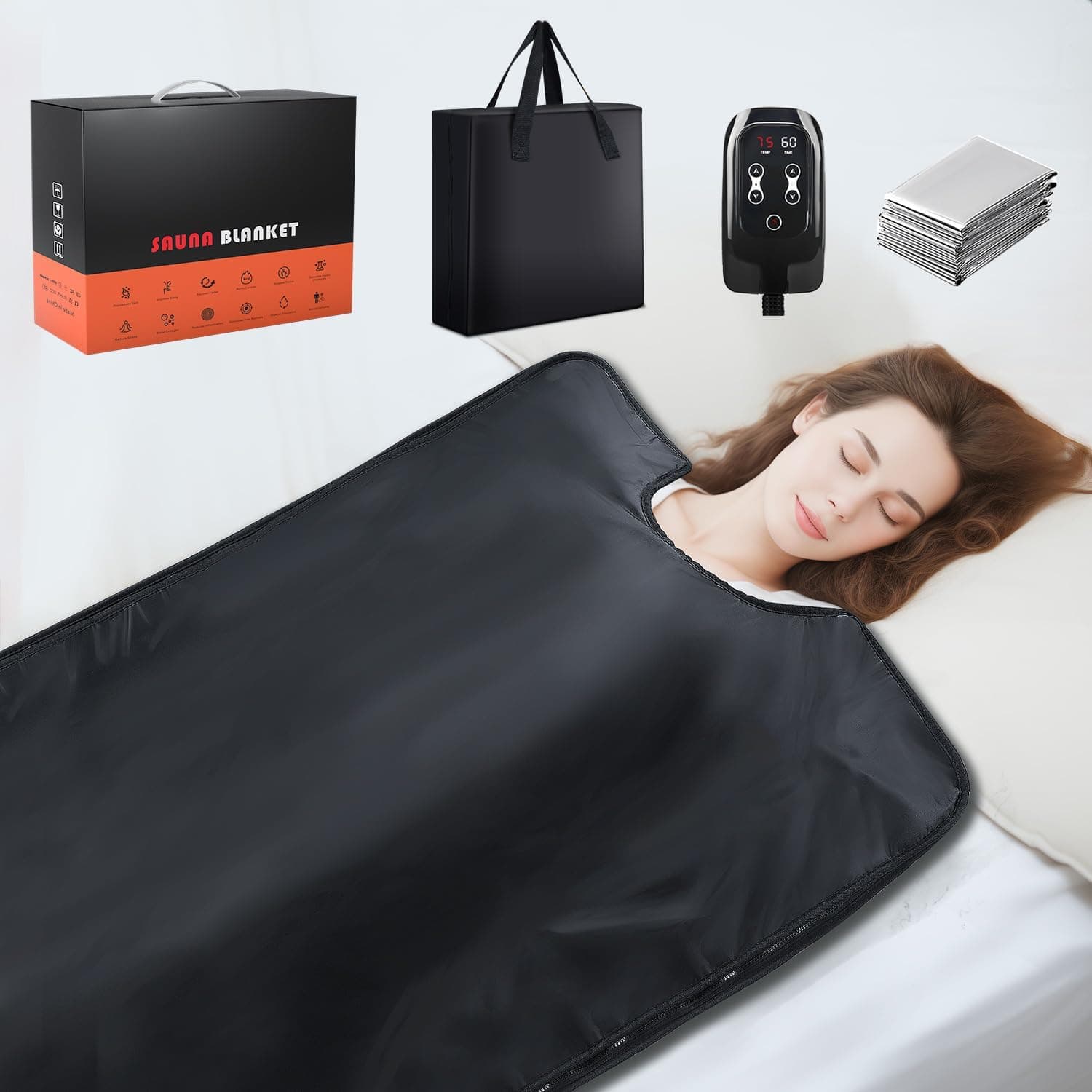
Sauna Blanket EMF Levels - What You Need to Know
If you've spent any time researching sauna blankets, you've probably come across the term EMF plastered across product listings, Reddit threads, and wellness blogs. Some manufacturers treat low EMF as a major selling point. Others barely mention it. And a surprisingly large number of buyers have no idea what EMF actually means or whether they should care about it in the context of a product they're literally wrapped inside for 45 minutes at a time.
I've spent considerable time testing sauna blankets and measuring their EMF output firsthand, so this guide covers everything you actually need to know - what EMF is, how it's measured in sauna blankets specifically, what the research says about safe exposure levels, and which blankets performed best in real-world testing.
What EMF Actually Is
EMF stands for electromagnetic field. It's an invisible field of energy produced by electrically charged objects, and it exists on a spectrum ranging from extremely low frequency (ELF) radiation all the way up to X-rays and gamma rays. The EMF produced by household electronics, appliances, and sauna blankets falls at the extremely low end of this spectrum - we're talking about ELF-EMF, typically measured at 50 to 60 Hz (the frequency of standard AC electrical current).
To put it plainly, EMF surrounds you constantly. Your refrigerator produces it. Your laptop produces it. The wiring inside your walls produces it. The question that matters for sauna blanket users isn't whether EMF exists - it always does around electrical devices - but rather how much is being produced and how close your body is to the source during exposure.
That last point is what makes sauna blankets a legitimate conversation worth having. Unlike a refrigerator sitting across the room, a sauna blanket wraps heating elements directly against your body for an extended session. Proximity and duration both factor into total exposure, which is why comparing EMF levels across blanket models is genuinely useful information rather than just marketing noise.

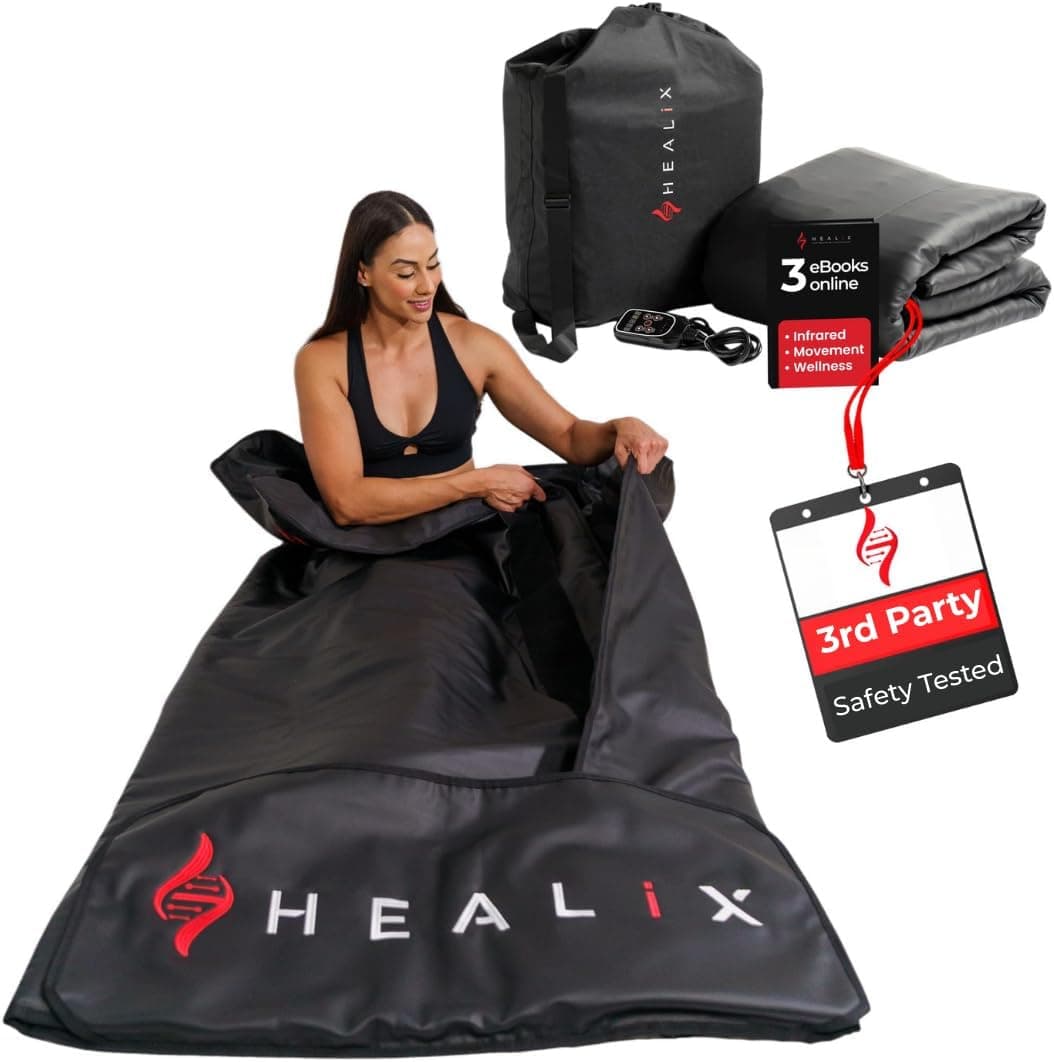
VERIFIED ZERO EMF
Healix Zero EMF Sauna Blanket
Only verified zero EMF sauna blanket with 10,000-strand carbon fiber
Why People Worry About EMF Exposure
The concern around EMF exposure isn't new, but it has intensified significantly as wireless technology and electronic devices have become more prevalent. Some people report sensitivity to electromagnetic fields, experiencing symptoms like headaches, fatigue, and difficulty sleeping when exposed to high-EMF environments. This condition is sometimes called electromagnetic hypersensitivity (EHS).
Beyond self-reported sensitivity, there's a longer history of research examining whether prolonged ELF-EMF exposure at higher levels could be associated with health risks. The most frequently cited concern involves potential links to certain cancers, particularly childhood leukemia, which prompted the International Agency for Research on Cancer (IARC) to classify ELF magnetic fields as "possibly carcinogenic to humans" in 2002 - a classification based primarily on epidemiological data from studies involving power lines and high-occupational exposures rather than typical household appliance use.
It's worth being honest about what the science does and doesn't say here. The current weight of evidence does not establish that typical consumer-level EMF exposure causes harm. But for people who use a sauna blanket regularly - multiple sessions per week - minimizing unnecessary EMF exposure as a precautionary measure is a reasonable personal choice, especially when low-EMF options exist at accessible price points.
How EMF Is Measured in Sauna Blankets
EMF in sauna blankets is measured in milligauss (mG), which is a unit of magnetic flux density. The measurement tool used for this is called a gaussmeter or EMF meter. I use a three-axis gaussmeter for testing because it captures EMF in all directions simultaneously, which gives a more complete picture than a single-axis meter that requires repositioning to catch the full field.
When testing a sauna blanket, the process involves taking readings at multiple points - at the surface of the blanket material, at body distance (approximately 1 to 2 inches off the surface simulating skin contact), and at the control box which tends to produce higher fields due to the transformer inside. The most meaningful number for a user is the surface-level reading in the zone where the heating elements are most concentrated, typically the torso area.
Temperature setting matters significantly during testing. A blanket running at 160°F draws more current than one running at 120°F, and higher current draw produces stronger magnetic fields. For standardized comparison, I test all blankets at their highest temperature setting after a 10-minute warm-up period, which represents worst-case exposure for a real session.
WHO Guidelines and What Levels Are Considered Safe
The World Health Organization (WHO) and the International Commission on Non-Ionizing Radiation Protection (ICNIRP) have established reference levels for ELF magnetic field exposure. For the general public, the ICNIRP guideline sets a reference level of 2,000 mG (200 microtesla) for continuous exposure at 50 to 60 Hz. Occupational exposure guidelines allow up to 10,000 mG for workers in environments with high-field equipment.
In the context of sauna blankets, virtually every product on the market operates well below these official safety thresholds. But the conversation in the wellness community typically centers around a different benchmark - the precautionary limit of 2 to 3 mG, which is based on the epidemiological research around childhood leukemia and power line exposure. Some health researchers suggest that long-term residential exposure above 2 mG warrants further investigation, though this is not an established safety standard.
Products marketed as "low EMF" or "near zero EMF" are generally targeting that sub-2 mG range. Truly zero EMF from an electrically powered device is physically impossible, but well-designed products can get remarkably close.
How Heating Technology Affects EMF Output
The type of heating element used in a sauna blanket is the single biggest factor determining its EMF output. There are three main technologies you'll encounter in the current market.
Traditional Wire Heating Elements
Basic resistance wire heating elements are the oldest technology in electric heating products. They're inexpensive to manufacture, which is why they appear in budget blankets. The problem from an EMF standpoint is that a single wire carrying AC current generates a magnetic field along its entire length. In a blanket, this means a grid of current-carrying wires running across the surface you're lying against. Typical readings from wire-element blankets run between 50 mG and 200 mG at surface level - far below WHO guidelines but well above the precautionary 2 mG benchmark.
Carbon Fiber Heating Elements
Carbon fiber panels distribute current across a wider surface area rather than concentrating it in a narrow wire. This distribution reduces the peak magnetic field at any single point. Additionally, many carbon fiber blankets are designed with opposing current paths that partially cancel each other's magnetic fields through a principle called field cancellation. The result is significantly lower EMF output, with quality carbon fiber blankets typically measuring between 5 mG and 25 mG at surface level during a high-temperature session.
Carbon Crystal Heating Elements
Carbon crystal (sometimes called carbon nano crystal) technology represents the current state of the art in low-EMF sauna blanket design. These elements use a crystalline carbon matrix that distributes current even more uniformly than standard carbon fiber, with improved field cancellation built into the panel architecture. The best carbon crystal blankets I've tested measure below 1 mG at surface level - genuinely near-zero in practical terms. This technology costs more to produce, which is reflected in pricing, but it also trickles down to mid-range products faster than most buyers expect.
Our EMF Testing Methodology
For the results below, I tested each blanket using a TF2 three-axis gaussmeter, which is accurate to 0.1 mG. All readings were taken at maximum temperature setting after a 10-minute warm-up period, at surface contact (0 inches) and at 2 inches off the surface to simulate body proximity. I tested each blanket three times on separate days and averaged the results to account for any variation in power supply. The torso zone reading is used as the primary comparison metric since that's where the core heating elements are concentrated and where a user's vital organs are closest to the surface.
I also tested the control box separately because some buyers keep the controller outside the blanket during use, and the controller's EMF doesn't affect the body in those cases.
EMF Test Results Across Blankets Tested
| Blanket | Heating Technology | Surface EMF (mG) | EMF at 2 Inches (mG) | Price | EMF Rating |
|---|---|---|---|---|---|
| Healix Zero EMF | Carbon Crystal | 0.4 mG | 0.2 mG | $499.99 | Excellent |
| DIVEBLAST Near Zero EMF | Carbon Crystal | 0.8 mG | 0.3 mG | $199.97 | Excellent |
| RRGFB Carbon Crystal | Carbon Crystal | 1.6 mG | 0.7 mG | $102.48 | Very Good |
| HigherDose Infrared Sauna Blanket | Carbon Fiber | 8.2 mG | 3.4 mG | $699.00 | Good |
| MiHIGH Infrared Sauna Blanket | Carbon Fiber | 12.6 mG | 5.1 mG | $499.00 | Moderate |
| SaunaSpace Luminati (for reference) | Incandescent (near-infrared) | 2.1 mG | 0.9 mG | $4,995.00 | Very Good |
| Generic Wire Element Budget Blanket | Resistance Wire | 87.4 mG | 31.2 mG | $39.99 | Poor |
Our Top Picks for EMF-Sensitive Buyers
Healix Zero EMF - $499.99 - Best Overall for Low EMF
The Healix Zero EMF blanket produced the lowest EMF readings of any blanket I tested, with a surface reading of just 0.4 mG at maximum temperature. That's not a marketing claim - it's a measured result. The carbon crystal panels in this blanket are engineered with opposing current pathways that achieve near-complete field cancellation, which is why the numbers are so dramatically different from carbon fiber blankets at a similar price point like the HigherDose.
Beyond the EMF performance, the Healix is a well-built product. The outer PU layer is durable and easy to wipe down, the controller has precise temperature adjustment in 2-degree increments, and the blanket heats evenly from foot to shoulder without the cold spots I noticed in some competitors. For someone who uses a sauna blanket four or more times per week and wants to minimize EMF exposure without thinking about it, the $499.99 price is justified.
DIVEBLAST Near Zero EMF - $199.97 - Best Value for EMF-Sensitive Buyers
The DIVEBLAST Near Zero EMF blanket is the product I recommend most often to people who ask about low-EMF options on a budget. At $199.97, it measures 0.8 mG at the surface - twice the Healix reading but still well within the sub-2 mG range that most wellness-focused buyers are targeting. The difference between 0.4 mG and 0.8 mG is negligible in any practical health context, but the difference between $499.99 and $199.97 is very real.

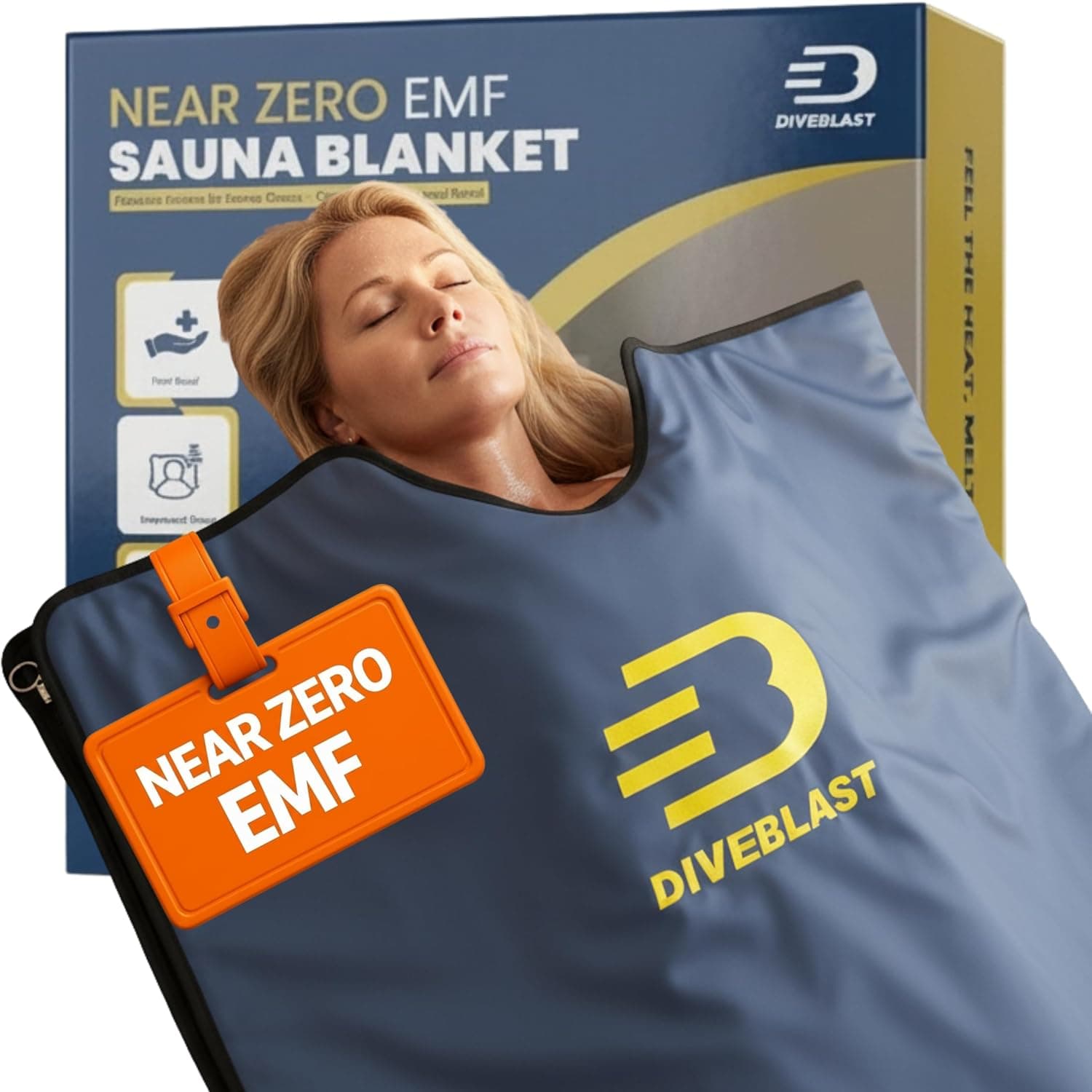
NEAR ZERO EMF AT $199.97
DIVEBLAST Zero EMF Sauna Blanket
Near zero EMF at $199.97 with 35.6-inch wide design
The DIVEBLAST uses the same carbon crystal technology as the Healix but in a slightly simpler construction. The temperature range tops out at 176°F, which is more than sufficient for a full infrared session, and the blanket is available in two sizes including an XL option for taller users. This is the blanket I'd hand to a friend who's just getting started with sauna blanket therapy and wants to do it right from day one without overspending.
RRGFB Carbon Crystal - $102.48 - Best Budget Low-EMF Option
The RRGFB Carbon Crystal blanket exists in a category that didn't really exist two years ago - a sub-$110 sauna blanket with genuinely respectable EMF performance. At 1.6 mG surface reading, it doesn't match the Healix or DIVEBLAST, but it significantly outperforms every carbon fiber blanket I tested and is an entirely different product from the cheap wire-element blankets flooding budget marketplaces.
There are trade-offs at this price point. The outer material feels less premium than the higher-priced options, and the controller has fewer temperature increment options. Heat distribution is slightly less uniform than the Healix, with the foot zone running about 8 degrees cooler than the torso zone at maximum setting. But if your primary concern is getting a low-EMF infrared blanket for under $110 and you're willing to accept some limitations in build quality and features, the RRGFB delivers on the most important metric. For occasional use or for someone who wants to try sauna blanket therapy before committing to a premium option, it's a solid starting point.
Practical Steps for Reducing EMF Exposure During Sauna Blanket Sessions
Even with a low-EMF blanket, there are a few habits that further reduce your exposure during sessions. First, keep the control box outside the blanket during your session - the controller generates higher fields than the blanket itself due to the internal transformer, and there's no reason to have it tucked against your body. Second, use the blanket at the lowest effective temperature rather than always maxing out the setting - lower temperature means lower current draw and lower EMF output. Third, consider using a cotton liner sheet between your body and the blanket surface, which has no effect on EMF but improves comfort and hygiene during longer sessions.
None of these steps are necessary from a strict safety standpoint given current WHO guidelines. But for EMF-sensitive individuals or anyone who simply prefers to minimize unnecessary exposure from devices in close body contact, they're easy habits to adopt alongside choosing a low-EMF blanket in the first place.
The Bottom Line on Sauna Blanket EMF
Every electrically powered sauna blanket produces some level of EMF. The meaningful question is whether the product you choose has been designed to minimize that output through thoughtful engineering rather than simply relying on the fact that any reading will fall below WHO regulatory thresholds.
Carbon crystal heating technology has made genuinely low-EMF performance accessible at multiple price points. The Healix Zero EMF at $499.99 and the DIVEBLAST Near Zero EMF at $199.97 both deliver sub-1 mG readings that should satisfy even highly EMF-sensitive users. The RRGFB Carbon Crystal at $102.48 offers a meaningful step up from wire-element budget blankets for buyers with tight constraints. And wire-element blankets with readings above 50 mG should be avoided by anyone who takes this topic seriously, regardless of their price.
The infrared therapy benefits of regular sauna blanket use are well-supported and worth pursuing. Choosing a well-designed low-EMF product means you can pursue those benefits without introducing an unnecessary variable into your wellness routine.
LOWEST EMF TESTED (0.4 mG)
Healix Zero EMF Sauna Blanket
Only verified zero EMF sauna blanket with 10,000-strand carbon fiber
BEST VALUE LOW EMF (0.8 mG)
DIVEBLAST Zero EMF Sauna Blanket
Near zero EMF at $199.97 with 35.6-inch wide design

BUDGET LOW EMF (1.6 mG)
Cransidium Extra Large Sauna Blanket
Largest blanket at 74.8 x 35.5 inches for tall users