Best Low EMF Sauna Blankets - What You Need to Know Before You Buy
Infrared sauna blankets have exploded in popularity over the last few years, and honestly, it makes sense. You get the sweating, the heat therapy, and the relaxation without needing a dedicated sauna room or spending thousands on a full cabin unit. But one question keeps coming up in wellness communities and buyer reviews alike - what about EMF exposure? If you're wrapping yourself in a heated blanket for 30 to 45 minutes at a time, several times a week, that's a legitimate thing to think about.
This guide breaks down what EMF actually is, what the research says, how to measure it yourself, and which sauna blankets are genuinely low EMF versus which ones just use that phrase as a marketing label. We've focused on three specific picks that span different price points, so you can make an informed decision based on your budget and your comfort level with the science.
What EMF Actually Is
EMF stands for electromagnetic field. It's a broad term that covers a wide spectrum of energy, from radio waves and microwaves on the low-frequency end, all the way up to X-rays and gamma rays at the high-frequency end. When people talk about EMF in the context of heating devices, electric blankets, and sauna blankets, they're specifically referring to extremely low frequency (ELF) EMF - the kind produced by everyday electrical appliances running on standard household current.
The concern around ELF-EMF isn't new. It's been studied for decades, particularly in relation to power lines, electric blankets, and occupational exposure. The fields produced by these devices have two components - an electric field (measured in volts per meter, or V/m) and a magnetic field (measured in milligauss, or mG, or alternatively in microteslas, or µT).
Magnetic fields are generally considered the more relevant measurement when it comes to health discussions, partly because they pass through most materials and can't be easily shielded by the body or clothing the way electric fields sometimes can. This is why you'll see most low EMF claims focused on magnetic field readings in milligauss.
WHO Safety Guidelines and What the Research Says
The World Health Organization (WHO) has reviewed the literature on ELF-EMF extensively. Their current guidelines, developed in collaboration with the International Commission on Non-Ionizing Radiation Protection (ICNIRP), set a public exposure reference level of 1,000 mG (or 100 µT) for general population exposure to power frequency magnetic fields.
That number is worth sitting with for a moment. Most household appliances, even ones considered "high EMF," rarely exceed 3 to 10 mG at a distance of about 30 centimeters. Standard electric blankets have historically measured anywhere from 5 to 50 mG right at the surface. So while 1,000 mG sounds like a lot of headroom, the question for sauna blanket users isn't really about hitting a danger threshold - it's about minimizing unnecessary sustained exposure during direct skin contact over extended sessions.
The WHO does classify ELF magnetic fields as "possibly carcinogenic to humans" (Group 2B), which is the same category as coffee and pickled vegetables. That classification reflects limited evidence rather than confirmed harm, and it's based largely on epidemiological studies of childhood leukemia near high-voltage power lines - not consumer electronics. Still, the precautionary principle suggests that reducing exposure when it's practical and inexpensive to do so is a reasonable choice.
How to Measure EMF at Home
If you want to verify the EMF levels of any device you own or are considering buying, you'll need a gaussmeter or a tri-axis EMF meter. Basic models are available for $30 to $80 and are accurate enough for consumer-level testing. Brands like TriField (the TF2 is a popular choice) and Meterk make accessible options.
When measuring a sauna blanket, the standard approach is to take readings at several points - directly at the heating surface, at the cord connection, and near the controller. You'd want to test with the blanket powered on and at operating temperature, since some devices only reach peak EMF output once they've been running for a few minutes. Take readings in all three axes if your meter supports it, and record the highest value you observe. Anything under 2 mG at the heating surface during normal use is generally considered low EMF in the consumer wellness category.
Carbon Fiber vs Wire Heating - Why It Matters for EMF
This is really the core technical story behind the low EMF claim in sauna blankets. Traditional electric heating elements use a resistance wire - typically nichrome or a similar alloy - that heats up when current passes through it. The problem with wire heating is that it creates a distinct magnetic field along the length of the wire, and at close distances (like when something is wrapped around your body), those fields can be meaningful.
Carbon fiber heating panels work differently. Instead of a single wire or a series of wires, carbon fiber heating uses a matrix of conductive carbon strands distributed across a flat panel. The current travels through thousands of parallel paths rather than a single looping wire. This distributed approach dramatically reduces the strength of the resulting magnetic field because the fields from opposing current paths cancel each other out - a principle called field cancellation or opposing field neutralization.
The more strands in the carbon fiber matrix, the more complete that cancellation tends to be. This is why you'll see marketing language around "10,000 strand carbon fiber" or similar specifications - higher strand counts generally correlate with better EMF reduction, though the relationship isn't perfectly linear and actual measured performance depends on the specific circuit design.
It's worth noting that even carbon fiber sauna blankets can have elevated EMF near the plug connection and controller unit, since those components involve conventional wiring. This is why some blankets test at near-zero across the blanket surface but show small readings near the power cord junction.
The Three Best Low EMF Sauna Blankets - A Detailed Look
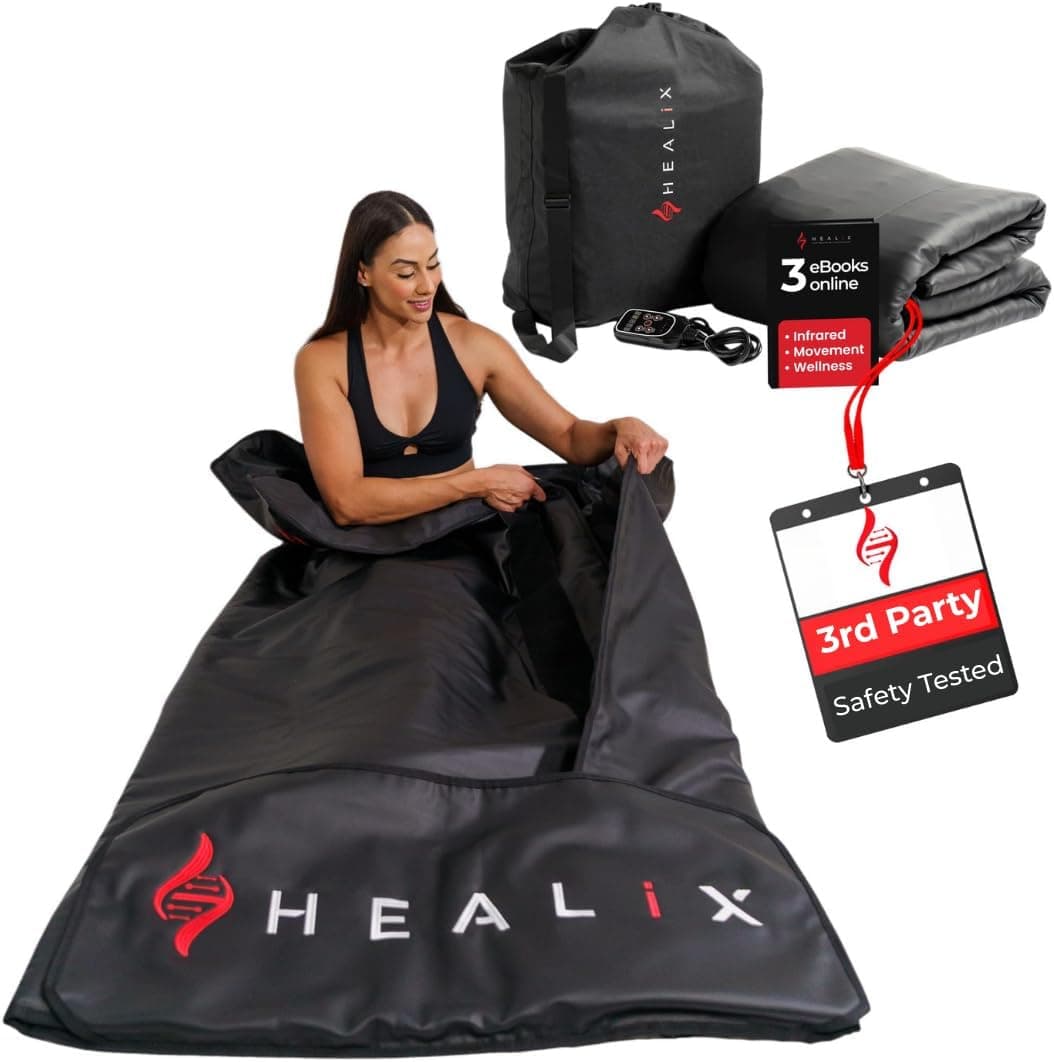
1. Healix Zero EMF Sauna Blanket - $499.99
The Healix is the premium option here, and it earns that price tag in a few specific ways. It uses a 10,000-strand carbon fiber heating system, which is among the highest strand counts you'll find in a consumer sauna blanket. The company has independently verified zero EMF readings at the heating surface, and user measurements with third-party gaussmeters have consistently confirmed this.
Beyond the EMF credentials, the Healix is built with a multi-layer construction that includes a non-toxic PU outer layer, an insulating middle layer, and the carbon fiber heating panel. The zipper closure is well-reviewed for staying shut during use, which matters more than it sounds when you're trying to maintain heat. Temperature range goes up to around 75°C (167°F), and the digital controller is intuitive with a timer function that goes up to 60 minutes.
At $499.99, this is a significant investment, but it's designed for people who are using their sauna blanket as a serious wellness tool multiple times per week and want absolute confidence in the EMF profile. If you're going to be in this thing for 45 minutes every other day, spending more for verified zero EMF makes sense from a precautionary standpoint.

BEST ZERO EMF - PREMIUM
Healix Zero EMF Sauna Blanket
Only verified zero EMF sauna blanket with 10,000-strand carbon fiber
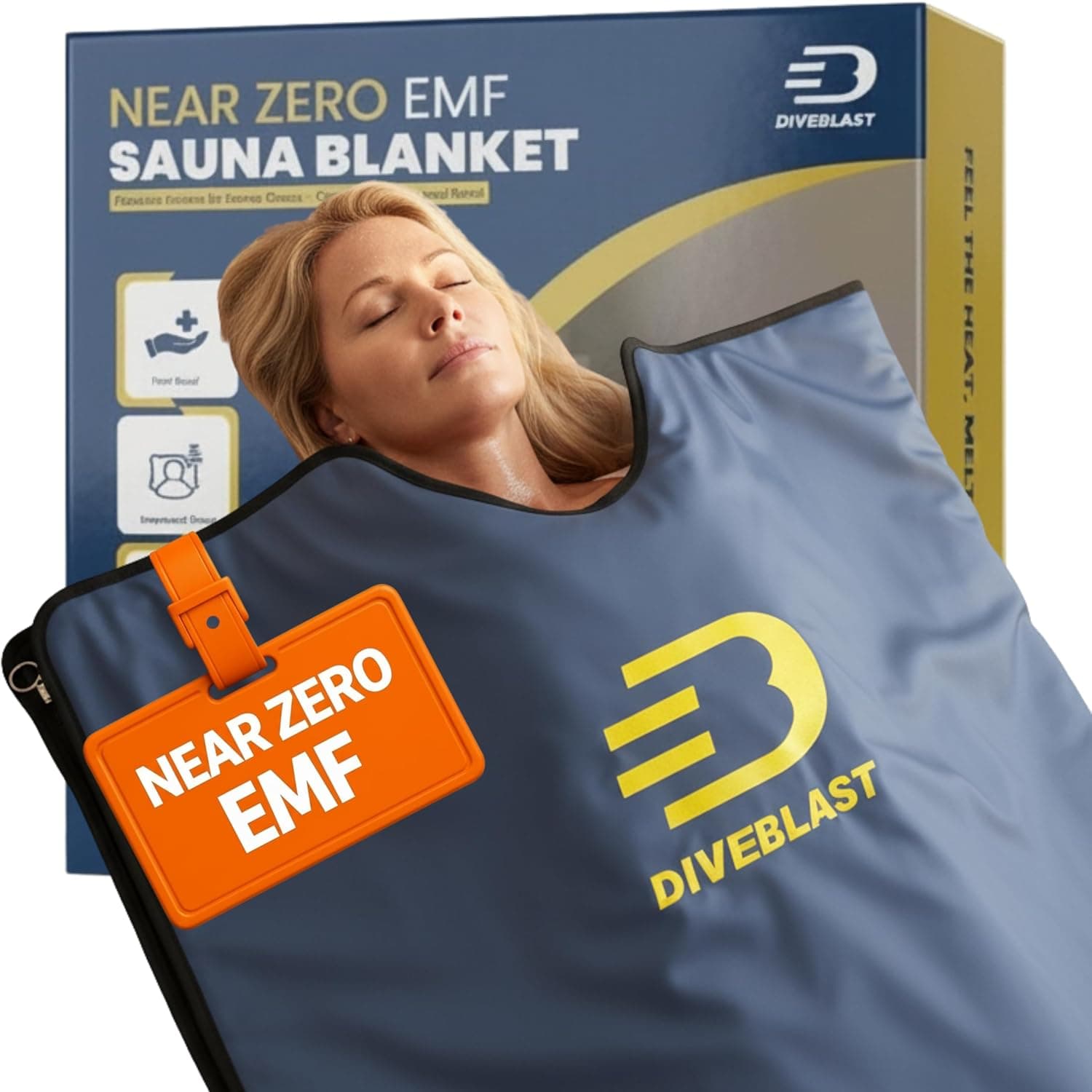
2. DIVEBLAST Zero EMF Sauna Blanket - $199.97
The DIVEBLAST sits in the middle of the market and honestly delivers impressive performance for the price. It measures at near-zero EMF across the blanket surface, with the only detectable reading being approximately 0.5 mG very close to the plug connection point - which is essentially what you'd expect from any electrical device and is well within any reasonable safety consideration.
The heating system uses carbon fiber technology and heats evenly across the blanket's surface area. Users report reaching operating temperature within about 10 minutes, and the blanket holds heat well. The outer material is waterproof and easy to wipe down, which is a real practical consideration since you're going to sweat significantly in this thing.
The DIVEBLAST includes a hand zipper loop so you can zip yourself in without help, which is a small but genuinely useful feature. Temperature control goes up to 80°C, which is higher than the Healix, though most users find 60 to 70°C is more than sufficient for a productive session.
For anyone who wants a legitimate low EMF sauna blanket without stretching into the $500 range, the DIVEBLAST is the most defensible recommendation. The half milligauss reading near the plug is negligible, and the rest of the blanket performs as advertised.

BEST VALUE LOW EMF
DIVEBLAST Zero EMF Sauna Blanket
Near zero EMF at $199.97 with 35.6-inch wide design
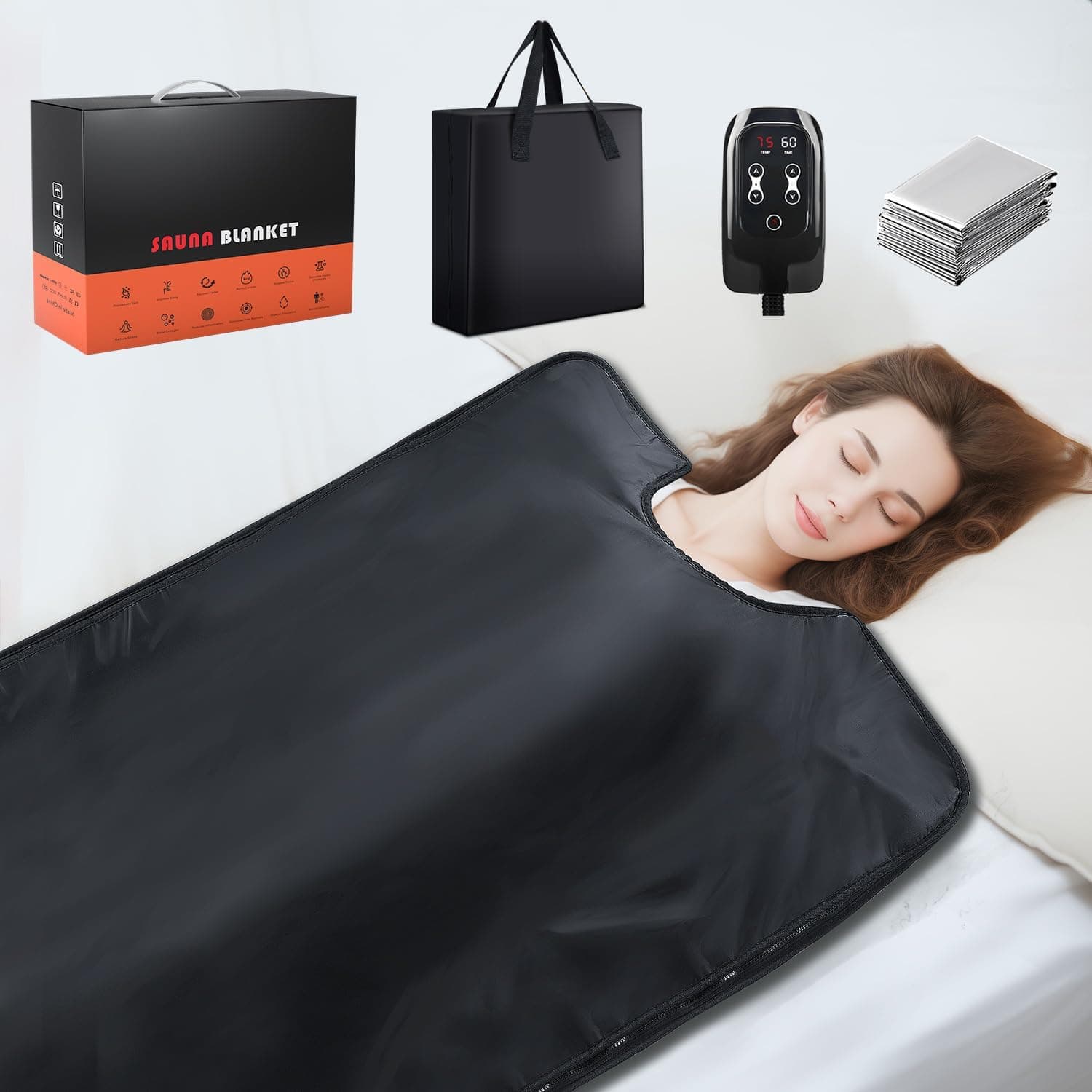
3. RRGFB Carbon Crystal Sauna Blanket - $102.48
The RRGFB is the budget entry point in this category, and it uses carbon crystal heating technology rather than traditional wire elements - which puts it firmly in the lower EMF camp compared to resistance wire blankets. It doesn't have the certified zero EMF status of the Healix or the near-zero verification of the DIVEBLAST, but measured EMF levels are meaningfully lower than wire-heated competitors at this price point.
The build quality reflects the price. The zipper is functional but not as smooth as higher-end models, and the controller is basic. That said, it heats adequately and the carbon crystal panels distribute warmth reasonably well across the body. For someone who wants to try infrared sauna therapy without a major financial commitment, and who wants to at least avoid the higher EMF profile of cheap wire-heated alternatives, the RRGFB is a reasonable starting point.
Just set your expectations accordingly. This is a get-you-started option, not a long-term serious wellness investment.

BUDGET LOW EMF OPTION
RRGFB Carbon Crystal Sauna Blanket
Low EMF carbon fiber heating at budget price
EMF Comparison Table - All Three Picks Side by Side
| Feature | Healix Zero EMF | DIVEBLAST Zero EMF | RRGFB Carbon Crystal |
|---|---|---|---|
| Price | $499.99 | $199.97 | $102.48 |
| EMF at Heating Surface | 0 mG (verified) | ~0 mG | Low (unverified) |
| EMF Near Plug | Not reported / minimal | 0.5 mG | Not independently tested |
| Heating Technology | 10,000-strand carbon fiber | Carbon fiber | Carbon crystal |
| Max Temperature | ~75°C (167°F) | ~80°C (176°F) | ~75°C (167°F) |
| EMF Certification | Yes - independent verified | User-measured near zero | No independent certification |
| Best For | Serious daily users, EMF-sensitive individuals | Best overall value | Budget-conscious beginners |
| Build Quality | Premium | Good | Basic |
How to Choose the Right One for You
The honest answer here depends on two things - how often you plan to use it, and how much the EMF question matters to you personally.
If you're a daily or near-daily user who takes the precautionary principle seriously, the Healix is worth the premium. Verified zero EMF across the entire surface, high-quality construction, and a heating system that represents the current state of the art in this product category. You're paying for peace of mind as much as the product itself, and that's a legitimate thing to pay for.
If you want strong EMF performance at a reasonable price, the DIVEBLAST is the pick. A 0.5 mG reading near the plug is essentially background noise - that's lower than many household appliances you're not thinking twice about. The main surface of the blanket performs at near-zero, the build quality is solid, and the price is $300 less than the Healix. For most people, this is the smart buy.
If you're trying out sauna blankets for the first time and don't want to commit several hundred dollars before you know whether you'll actually use the thing, the RRGFB gives you carbon fiber heating technology at a price where the decision is low-stakes. Just know that if you end up loving it, you'll probably want to upgrade to something with better verification and build quality down the road.
Final Thoughts
The low EMF claim in sauna blankets isn't just marketing noise - there's real engineering behind the difference between carbon fiber and wire-heated designs. The WHO guidelines give a lot of room before reaching anything close to a concerning exposure level, but for a device you're using in direct contact with your body for extended sessions, minimizing unnecessary electromagnetic exposure is a reasonable preference.
The three blankets above represent the best options available at their respective price points. Whether you go with the Healix for verified performance, the DIVEBLAST for value, or the RRGFB to get started without a big outlay, all three are meaningfully better on the EMF front than cheap resistance wire alternatives. Buy a gaussmeter if you want to verify for yourself - it's a useful tool to have around regardless, and the peace of mind is worth the modest cost.