Sauna Blanket for Autoimmune Conditions - Hashimoto's, Lupus, MS, and What the Evidence Shows
Readers with autoimmune diagnoses write to me more often than almost any other group. The most common questions come from people living with Hashimoto's thyroiditis, systemic lupus erythematosus, multiple sclerosis, rheumatoid arthritis, and a longer list of less-common conditions. The question is always some variant of the same thing: can a sauna blanket help, is it safe given my diagnosis, and what does the research actually say? I have spent considerable time in the primary literature on this, and the honest answer has real nuance - there is evidence of symptomatic benefit across several related conditions, there are real safety considerations that differ by diagnosis, and the disease-modifying claims that some marketing pages make are not supported by the data.
This article walks through what we know, what we do not know, and what a reasonable person with an autoimmune condition should think about before starting a sauna blanket practice.
The State of the Evidence - Symptomatic Relief, Not Disease Modification
Here is the first thing to understand about the research base: no peer-reviewed randomized trial has specifically tested infrared sauna blankets in Hashimoto's, lupus, or multiple sclerosis. Every benefit claim you see in the marketing space extrapolates from studies done in related conditions (rheumatoid arthritis, ankylosing spondylitis, chronic pain, type 2 diabetes) or from mechanism-level work on heat shock proteins, endothelial function, and oxidative stress.
The extrapolation is not unreasonable. The mechanisms that heat therapy appears to engage - heat shock protein expression, improved endothelial nitric oxide production, reduced systemic oxidative stress, and parasympathetic autonomic shift - are all plausibly relevant to the pathophysiology of several autoimmune conditions. But plausibility and demonstrated clinical benefit are different things. The most important framing for any reader with an autoimmune diagnosis is that sauna blankets may help manage symptoms - pain, stiffness, fatigue, sleep disturbance - but they are not going to alter your autoantibody levels, your thyroid hormone profile, your complement levels, or the trajectory of your disease in any documented way.
The Studies That Support Cautious Optimism
Kanji and colleagues (2006) conducted a pilot randomized controlled trial of regular sauna bathing in 12 patients with rheumatoid arthritis, published in Clinical Rheumatology. The four-week intervention at roughly 60 degrees Celsius produced significant reductions in pain and stiffness scores with no exacerbation of disease activity markers. This study is the most commonly cited evidence for the safety of heat therapy in inflammatory autoimmune conditions. It is small, it is old, and it is specifically about RA - but the safety signal is clean.
Masuda et al. (2005, Psychotherapy and Psychosomatics; PubMed 16155316) examined repeated thermal therapy in chronic pain patients and documented pain score reductions on the order of 70 percent that persisted beyond the treatment window. A companion study from the same group in 2005 (Journal of the American College of Cardiology; PubMed 16098438) showed improved endothelial function and reduced oxidative stress markers after 3 months of FIR sauna (60 degrees Celsius, 15 minutes, five times per week).
Leung and colleagues (2011, Alternative Medicine Review; PubMed 21951023) published a broad clinical review documenting sauna use across cardiovascular, autoimmune, and toxicant-induced conditions, concluding that heat therapy appears to improve circulation, reduce inflammation, and support symptomatic management across multiple inflammatory states. The quality of the evidence behind that review was mixed - mostly small trials and mechanistic work - but the pattern of results was coherent.
The anecdotal case reports and observational data are substantial in volume but low in rigor. Survey data from thyroid and autoimmune patient communities routinely reports 40 to 60 percent of respondents describing improvement in symptoms (fatigue, joint pain, sleep, brain fog) with regular sauna use. These surveys cannot separate sauna effect from placebo, regression to the mean, or concurrent lifestyle change, but the consistency of the pattern is worth noting.
Hashimoto's Thyroiditis - What to Expect
Hashimoto's is characterized by autoimmune destruction of thyroid tissue with resulting hypothyroidism, and the common symptom burden includes fatigue, cold intolerance, cognitive fog, muscle aches, dry skin, and weight management challenges. The published evidence on sauna blankets specifically for Hashimoto's is absent; the extrapolated case rests on improvements in the related symptomatic spectrum (fatigue, pain, skin) seen in other populations.
What you should not expect: any change in TSH, free T4, free T3, or thyroid antibody (anti-TPO, anti-Tg) levels from sauna blanket use. Your thyroid medication dose, your functional lab picture, and your autoimmune activity are not variables that heat therapy moves in any documented way.
What some Hashimoto's patients report: improved subjective energy in the hours after a session, better sleep quality on session nights, reduced muscle stiffness, improvement in cold-intolerance symptoms (the warm sensation persists for hours), and improved mood. These are meaningful quality-of-life wins even without disease modification, and they are consistent enough across reports that I consider them a reasonable expectation. Start conservatively - Hashimoto's patients are sometimes more sensitive to heat-induced fatigue than the general population - and build up gradually.
Systemic Lupus Erythematosus - The Safety Conversation Matters
Lupus introduces a specific complication that other autoimmune diagnoses do not share to the same degree: photosensitivity. SLE patients can flare in response to UV light, and a meaningful minority react to heat as well. The good news on the sauna blanket front is that far-infrared wavelengths are not UV - the photosensitivity mechanism is different, and in the RA and other inflammatory condition literature, there is no signal of disease-activity worsening with heat therapy.
The caveats for lupus patients are real. Any lupus patient with active cardiovascular involvement (lupus cardiomyopathy, serositis, active vasculitis) should not start heat therapy without explicit rheumatology clearance. Lupus patients with Raynaud's phenomenon generally tolerate heat better than cold but should pay attention to the rebound vasoconstriction that can occur on session exit. Lupus patients on hydroxychloroquine, mycophenolate, or other immunosuppressants do not have a specific heat contraindication, but the fatigue patterns of these medications interact with heat-induced fatigue in ways that are worth tracking.
Start conservatively. A 15 to 20 minute session at 50 to 55 degrees Celsius, paired with careful hydration, is a reasonable first trial. If the post-session feeling is net positive at 24 hours - no flare, no worsened fatigue, no joint swelling - progress gradually. If it is net negative, it may not be the right modality for your presentation and that is worth respecting.
Multiple Sclerosis - The Uhthoff Problem and How to Work Around It
MS patients have a specific reason to approach heat therapy cautiously: Uhthoff's phenomenon. A modest rise in core body temperature - sometimes as little as 0.5 degrees Celsius - can transiently worsen MS symptoms (vision changes, fatigue, weakness, coordination problems) by slowing conduction in demyelinated axons. This is why many MS patients have a cold-shower or cooling-vest strategy for hot weather.
A sauna blanket will raise core temperature by 1 to 2 degrees Celsius in a typical session. For an MS patient, this is a meaningful thermoregulatory challenge. That does not mean sauna blankets are off-limits for MS, but it does mean the approach needs to be different.
The MS-friendly protocol I have collected from readers and from the small clinical literature on heat acclimation in MS populations is as follows: start with very short sessions (10 minutes maximum) at the lowest temperature setting (roughly 45 to 50 degrees Celsius). Build session length before building temperature. Plan an active cooling phase immediately after the session - a cool shower, a cool cloth on the neck, time in an air-conditioned room. Track symptoms at 30 minutes, 2 hours, and 24 hours post-session. If you see a clean pattern of transient Uhthoff symptoms that resolve within a few hours, the modality is probably tolerable for you with continued caution. If symptoms persist or you experience a pseudo-flare, this is likely not the right modality.
Some MS patients tolerate heat therapy well and report improvement in pain, spasticity, and sleep. Others cannot tolerate it at all. There is no way to know which category you are in without a careful trial, and the careful trial is worth doing only after a conversation with your neurologist.

Best for Cautious Autoimmune Introduction
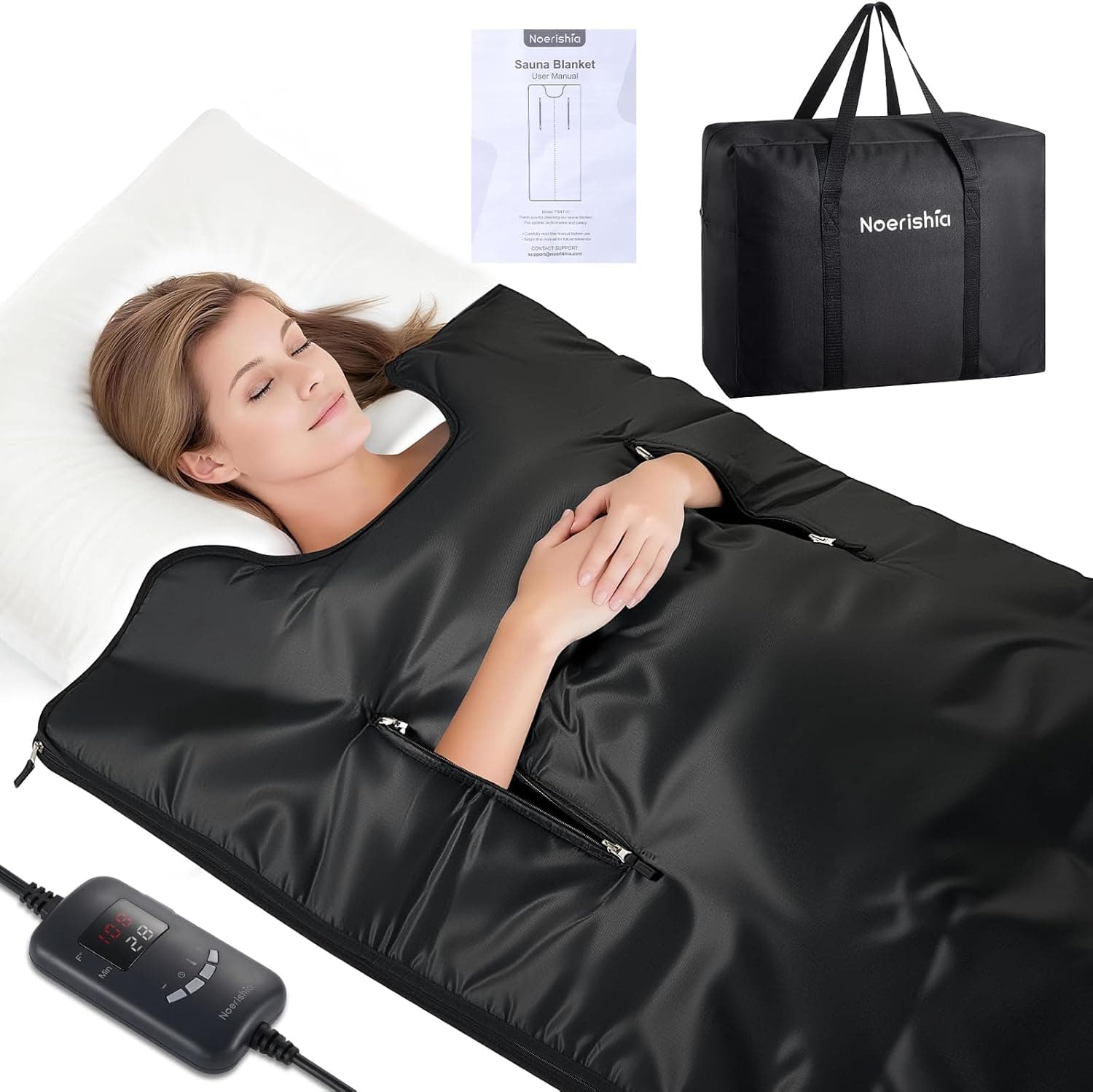
Noerishia Portable Sauna Blanket
A gentle-temperature, budget-friendly unit with accurate low-end heating (starts comfortably at 50 C). This is what I recommend for autoimmune patients running a cautious first trial - you can genuinely stay in the 45-55 C range and not push your thermoregulation harder than you want to. Machine-washable interior matters for sensitive skin presentations.
Rheumatoid Arthritis and Ankylosing Spondylitis
The evidence base here is the cleanest in the autoimmune space. The Kanji 2006 RA pilot and subsequent small trials have consistently shown symptomatic improvement (pain, stiffness, function) with 4 to 8 weeks of regular heat therapy, with no worsening of disease activity markers. A parallel ankylosing spondylitis small trial showed similar symptomatic gains.
For patients whose disease is well-controlled on their current DMARD or biologic regimen, adding heat therapy as a symptom-management tool is well-tolerated and modestly effective for pain and stiffness. For patients in an active flare with significantly elevated inflammatory markers, the evidence for starting heat therapy during the flare is weaker, and most rheumatologists advise deferring initiation until disease activity is back to the patient's baseline.
A reasonable RA/AS protocol is 30 to 40 minute sessions at 55 to 65 degrees Celsius, three to five times per week, maintained for at least 6 to 8 weeks before judging effectiveness. Morning sessions often produce the most noticeable stiffness reduction for the rest of the day.
Mechanisms That Might Explain the Symptomatic Benefit
Heat shock protein upregulation is the most biologically plausible mechanism. Heat shock proteins (particularly HSP70 and HSP90) are chaperone proteins that help refold misfolded proteins, and chronic inflammatory states generate substantial misfolded-protein load. Upregulating HSPs through repeated mild hyperthermia plausibly supports cellular homeostasis in autoimmune-affected tissues.
Endothelial nitric oxide synthase upregulation - the same mechanism that drives sauna's cardiovascular benefits - may also improve microcirculation in tissues affected by autoimmune damage. Reduced systemic oxidative stress (measured in some studies as 8-epi-PGF2-alpha reduction) may take some of the chronic load off tissues already dealing with immune-mediated damage.
Autonomic rebalancing toward parasympathetic dominance over weeks of regular heat therapy is another plausible contributor. Many autoimmune patients live in a sympathetic-dominant autonomic state, and the shift toward parasympathetic tone has been associated with symptom improvement in several conditions.
What heat therapy almost certainly does not do: it does not deplete pathogenic autoantibodies, it does not shift the Th17/Treg balance in ways that have been documented, and it does not modify the underlying immune activity of an autoimmune disease. The effects are at the level of tissue tolerance, symptom generation, and general physiological support - not at the level of the autoimmune process itself.
The Hydration, Medication, and Flare Interactions
Several interaction patterns are worth flagging for autoimmune patients. Immunosuppressants including mycophenolate, methotrexate, and biologics do not have a specific heat interaction, but they do often produce baseline fatigue that stacks with heat-induced post-session fatigue. Plan lower-intensity or shorter sessions than you might otherwise tolerate.
Corticosteroids (prednisone, methylprednisolone) at any meaningful dose warrant specific caution. The mineralocorticoid effects alter fluid balance, the steroid-induced skin thinning can increase burn susceptibility, and the general physiology of chronic steroid exposure is not a great match with heat stress. If you are in a steroid taper, it is probably the wrong window to be initiating or intensifying a heat therapy practice.
During an autoimmune flare (elevated inflammatory markers, active disease activity, new symptoms), heat therapy is not the right intervention. Defer until you are back to your baseline and cleared by your physician.
What to Watch For
For any autoimmune patient initiating heat therapy, the variables worth tracking over the first month are: subjective symptom burden (fatigue, pain, stiffness, cognition), sleep quality, any new or worsened symptom pattern, and any objective marker your physician is already tracking (labs, blood pressure, weight). If the subjective picture improves and nothing worsens objectively, the intervention is probably net positive for you and you can continue. If the subjective picture worsens or any objective marker trends in the wrong direction, discontinue and discuss with your physician before resuming.
Who Should Not Start a Sauna Blanket Practice Without Medical Clearance
Several autoimmune presentations warrant explicit physician clearance before initiating sauna blanket use: lupus with any cardiovascular involvement, MS in the first year of diagnosis or during an active relapse, any autoimmune condition currently in a flare, autoimmune skin conditions with active lesions on the trunk, any patient on high-dose corticosteroids, any patient with active infection, and any autoimmune patient with concurrent cardiac, renal, or significant pulmonary disease.
This is not an exhaustive list, and the better approach for any autoimmune patient is a one-sentence question to your treating physician: "Is there any specific reason I should not try a 20-minute home sauna blanket session twice a week at moderate temperature?" Most physicians will have an informed answer in the context of your specific disease, activity level, and medication regimen.
The Bottom Line on Sauna Blankets and Autoimmune Conditions
The evidence supports using a sauna blanket as a symptom management tool - not as a disease-modifying treatment - in autoimmune conditions where heat therapy has been shown safe in related inflammatory diseases. The strongest evidence is in rheumatoid arthritis and chronic pain syndromes. The extrapolated case for Hashimoto's is reasonable on mechanism and anecdote but lacks controlled trial data. Lupus requires photosensitivity awareness but does not appear to be contraindicated for far-infrared specifically. MS requires careful Uhthoff-aware protocol and is tolerated by some patients and not others.
For the autoimmune patient who is stable, not in flare, and has cleared the conversation with their physician, a sauna blanket can be a reasonable adjunct to a broader disease-management plan. Start conservatively, track your response carefully, give it 6 to 8 weeks before judging, and keep it in its proper role - an adjunct to, not a replacement for, the specialist-directed therapy that is actually modifying your disease.
References
- Kanji G et al. Efficacy of regular sauna bathing for patients with rheumatoid arthritis. Clin Rheumatol. 2006;25(2):240-243. PubMed
- Masuda A et al. The effects of repeated thermal therapy for patients with chronic pain. Psychother Psychosom. 2005;74(5):288-294. PubMed 16155316
- Masuda A et al. Repeated thermal therapy improves impaired vascular endothelial function. J Am Coll Cardiol. 2005;46(4):610-615. PubMed 16098438
- Beever R. The effects of repeated thermal therapy on quality of life in patients with type II diabetes mellitus. J Altern Complement Med. 2010. PubMed 20569062
- Leung TK et al. Sauna as a valuable clinical tool for cardiovascular, autoimmune, toxicant-induced and other chronic health problems. Altern Med Rev. 2011. PubMed 21951023
Related Reading
- Sauna Blanket Side Effects - Complete Risk Analysis
- Sauna Blanket for Chronic Fatigue and Long COVID
- Sauna Blanket for Fibromyalgia
- Sauna Blanket for Arthritis and Joint Pain
Informational only. Autoimmune conditions require specialist-directed care; do not use this article in place of a conversation with your treating physician.