Sauna Blanket for Chronic Fatigue Syndrome and Long COVID - Evidence and Protocol
The chronic fatigue syndrome (ME/CFS) and long COVID communities are unusually careful about new interventions, and rightly so. Both conditions are characterized by post-exertional malaise (PEM), a delayed and disproportionate worsening of symptoms after activity that for some patients can persist for days or weeks. Anything that promises symptomatic improvement has to be weighed against the very real risk of triggering a crash. Heat therapy in this space is one of the more genuinely interesting modalities because the published evidence - small but consistent - shows symptom benefit without the post-exertional cost that exercise interventions sometimes incur. This article walks through what we actually know, what to expect, the protocol with the cleanest evidence base, and the warning signs that mean stop.
What the Research Actually Shows
The strongest evidence for heat therapy in chronic fatigue states comes from Japanese clinical work using the Waon therapy protocol. Waon is a specific far-infrared therapy: 60-degree-Celsius dry sauna for 15 minutes followed by 30 minutes of warm rest, originally developed for chronic heart failure and subsequently extended to several chronic fatigue and pain syndromes.
Soejima and colleagues (2015, Internal Medicine; PubMed 25631065) treated 13 patients with chronic fatigue syndrome with five Waon sessions per week for four weeks. Significant reductions in fatigue scores (p less than 0.01), pain scores, and improvements in sleep quality were documented compared to baseline. A follow-up study by Fujii and colleagues (2020) extended the protocol to 12 weeks in 10 CFS patients and found 30 to 50 percent reductions on the Chalder Fatigue Scale alongside quality of life improvements.
Matsumoto et al. (2011, Clinical Rheumatology; PubMed 21340676) examined Waon therapy in fibromyalgia patients with prominent fatigue (a population with substantial overlap with ME/CFS) and documented 40 percent improvements in visual analog scale fatigue scores after four weeks of treatment.
Janssen and colleagues (2016, JAMA Psychiatry; PubMed 27172277) used a different heat therapy approach - whole-body hyperthermia delivered to a core temperature of 38.5 degrees Celsius - in depressed patients (some with prominent fatigue) and documented a 20 percent reduction in Hamilton Depression Scale scores from a single session, with mood and fatigue effects persisting for several weeks.
The long COVID literature is newer and thinner. Porcari and colleagues (2021, International Journal of Biometeorology) published a proposal arguing that spa heat therapies showing benefit in fibromyalgia would be reasonable to test in post-COVID fatigue, citing the inflammatory pattern overlap between the two conditions. The first dedicated whole-body hyperthermia trial in long COVID is currently underway through the Reagan-Udall Foundation, with results pending.
The cumulative picture is consistent: small studies, all showing meaningful fatigue reduction with regular heat therapy in chronic fatigue states, with no large randomized controlled trial yet completed and no major medical body recommending the intervention as standard of care.
The Mechanisms - Why Heat Therapy Plausibly Helps
The mechanistic case for heat therapy in chronic fatigue states rests on several converging biological pathways that overlap with what we know about ME/CFS and long COVID pathophysiology.
Heat shock protein induction is the most-cited pathway. HSP70 and related chaperone proteins protect mitochondrial function under stress, and mitochondrial dysfunction is a recurring finding in ME/CFS and long COVID research. Repeated mild hyperthermia upregulates HSP expression, plausibly supporting the impaired energy production that characterizes both conditions.
Anti-inflammatory effects are documented in heat therapy across multiple inflammatory states. Reductions in IL-6, CRP, and TNF-alpha have been measured in trials of regular sauna use. Chronic inflammation is a feature of long COVID in particular, and reducing the inflammatory background may translate to fatigue reduction.
Endothelial function improvement and improved microcirculation may address the impaired oxygen delivery and the subtle dysautonomia that contribute to fatigue in both conditions. The autonomic rebalancing toward parasympathetic dominance over weeks of regular use may also help with the dysautonomia component.
None of these mechanisms is sufficient on its own to explain the full clinical picture of either condition. The honest framing is that heat therapy is one input that may modulate several biological pathways relevant to chronic fatigue, with the symptomatic effect being the sum of several modest mechanism-level changes.
The Critical Issue - Post-Exertional Malaise
If you have ME/CFS or long COVID with PEM, the single most important variable in deciding whether and how to try heat therapy is the PEM threshold. The published Waon trials excluded patients with severe heat intolerance, and the Reagan-Udall WBH trial excludes patients with BMI over 40 and heat hypersensitivity. The trial protocols are explicitly designed to stay below the threshold that triggers a crash.
For a CFS or long COVID patient considering a sauna blanket, the protocol matters more than the intervention itself. Starting at the standard sauna blanket parameters (60-65 degrees Celsius for 30-45 minutes) is almost certainly the wrong starting point. Starting at the gentlest possible parameters (45-50 degrees Celsius for 8-10 minutes) and moving slowly upward only if PEM is not triggered is the right approach.
The PEM signature to watch for is delayed onset (often 24 to 72 hours after the trigger) of worsened fatigue, cognitive fog, sleep disturbance, and physical symptom flare that persists for days or weeks. If this pattern emerges after a sauna blanket session, the protocol exceeded your tolerance threshold and the next session - if any - needs to be at a meaningfully reduced parameter set.
The Cautious Starting Protocol
The protocol I would suggest for a CFS or long COVID patient cleared by their physician to try heat therapy is the following.
Week 1-2: 8 to 10 minute sessions at 45 degrees Celsius, twice per week. Track energy, cognition, and any PEM signature for 72 hours after each session before scheduling the next.
Week 3-4 if Week 1-2 was tolerated cleanly: 12 to 15 minute sessions at 50 degrees Celsius, twice per week.
Week 5-8 if continued tolerance: 20 to 25 minute sessions at 55 degrees Celsius, two to three times per week.
The published trial protocols ran longer sessions (15 to 30 minutes) at higher temperatures (60 degrees Celsius) for 4 to 12 weeks. That is a reasonable destination but it is the destination, not the starting point. CFS and long COVID populations have a much wider distribution of heat tolerance than the general population, and what worked in a Japanese trial cohort with specific selection criteria may not match your individual physiology. Build slowly.
The signs that the protocol is working: gradually improved subjective energy and cognition in the days after sessions, improved sleep quality, no PEM crash within 72 hours, and a slowly expanding tolerance for daily activity. The signs to stop: any clear PEM crash within 72 hours of a session, worsening rather than improving baseline fatigue over 2-3 weeks, new orthostatic symptoms, or any new symptom that does not resolve.

Best for the Cautious Low-Temperature Starting Protocol
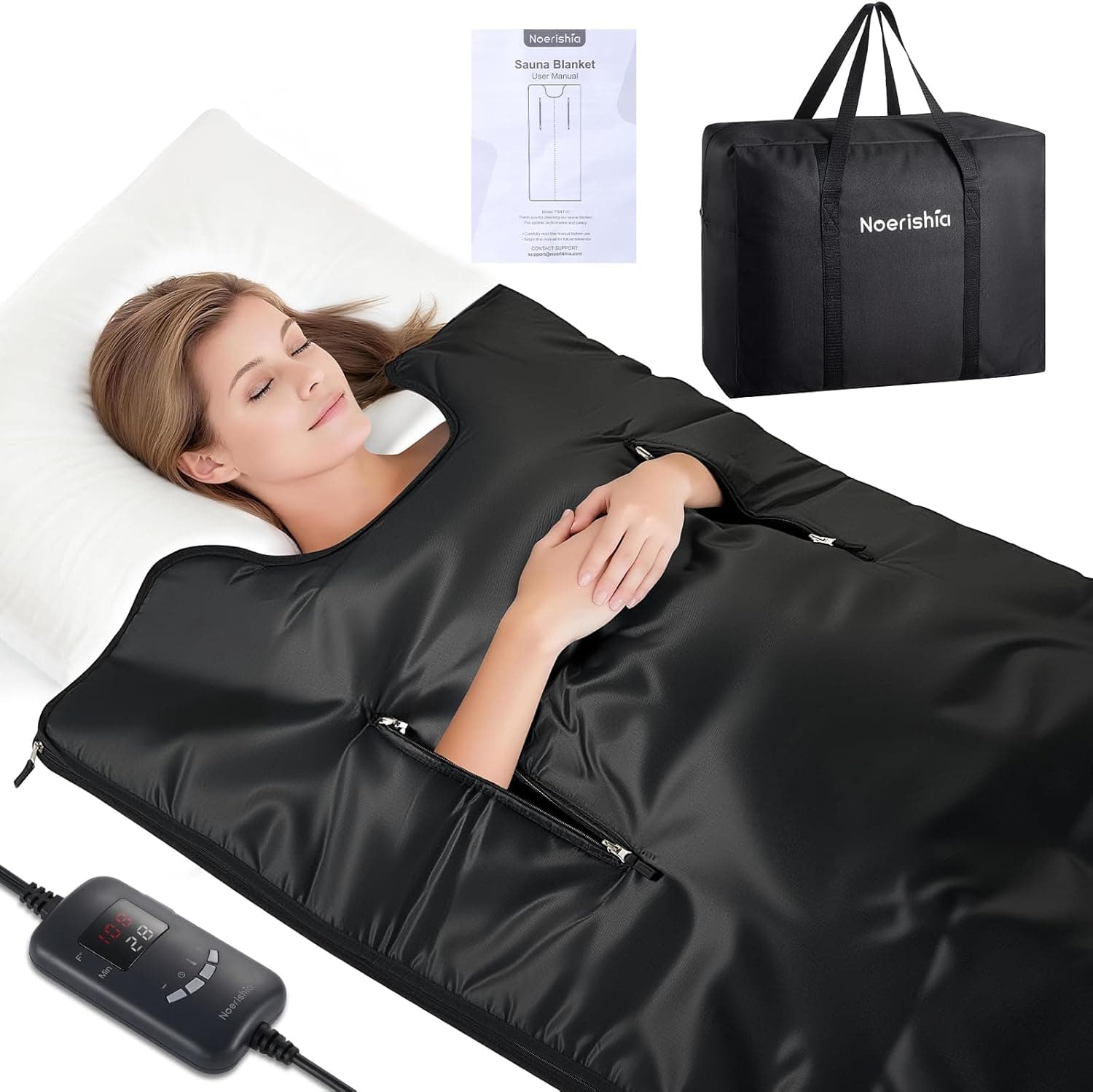
Noerishia Portable Sauna Blanket
For CFS and long COVID patients running a careful, low-temperature starting protocol, this is the unit I recommend. The accuracy at the low end of the temperature range matters - many cheaper blankets cannot hold a stable 45-50 C, and you need to know your dose precisely. Budget price keeps the experiment low-risk if heat does not turn out to be your modality.
The Long COVID Specifics
Long COVID is a heterogeneous condition with multiple phenotypes - cardiovascular, respiratory, cognitive, autonomic, fatigue-dominant, and others - and the heat therapy response may differ across these phenotypes. The cleanest extrapolation is to the fatigue-dominant phenotype, where the mechanistic overlap with ME/CFS is largest.
Patients with prominent post-COVID dysautonomia (POTS-pattern symptoms, orthostatic intolerance) need to be especially careful with heat therapy. Heat-induced vasodilation can worsen orthostatic symptoms, and the standard exit protocol becomes critically important. Some patients with POTS find that pre-session electrolyte loading (a high-sodium electrolyte drink 30 minutes before the session) helps stabilize the blood pressure response.
Patients with prominent post-COVID respiratory symptoms should clear heat therapy with their physician first, particularly if there is any residual interstitial change on imaging or any persistent oxygen desaturation. The respiratory work of breathing during a session can be elevated, and patients with reduced pulmonary reserve may not tolerate it.
Patients with post-COVID cardiovascular involvement (myocarditis, pericarditis, residual cardiac dysfunction) should not initiate heat therapy without explicit cardiology clearance.
Pacing and the Energy Envelope
The dominant non-pharmacologic strategy in ME/CFS management is pacing - staying within the energy envelope to avoid PEM. A sauna blanket session is a real energy expenditure even though it does not feel like one in the conventional sense. The hemodynamic and thermoregulatory load is non-trivial.
For a patient practicing pacing, a sauna blanket session counts in the daily energy budget. If your typical post-PEM-stable day allows for one significant activity, the sauna blanket session should be that one activity, not an addition to a normal day. Schedule session days as low-activity days. Plan recovery time after the session. Track heart rate response if you have a wearable that does it; abnormal post-session elevation can be an early warning of overdoing it.
What Heat Therapy Will and Will Not Do
The honest expectation for a CFS or long COVID patient running this protocol carefully is modest, gradual symptom improvement over weeks - improved energy, better sleep, reduced cognitive fog, possibly improvement in pain. The Waon trials saw 30 to 50 percent reductions in fatigue scores, which is clinically meaningful but not curative. None of the published work shows reversal of the underlying condition, and the framing of heat therapy as a cure for either ME/CFS or long COVID is not supported.
For some patients, the intervention will not work or will not be tolerable. The published trials did not include data on non-responders, but anyone working in this space should expect that a meaningful minority of patients will not benefit from heat therapy and a small percentage will not tolerate it at all. Knowing within 4-6 weeks whether you are a responder is the goal of the cautious starting protocol.
Hydration, Electrolytes, and Recovery
The hydration considerations for chronic fatigue patients are amplified versions of the general guidance. Pre-session hydration with water and electrolytes is more important than usual. During-session sipping of water keeps the fluid loss more gradual. Post-session electrolyte replenishment is non-negotiable - dehydration on top of CFS dysautonomia can produce orthostatic events that take days to recover from.
A high-sodium electrolyte powder is particularly useful in this population. Many CFS and long COVID patients already use higher-than-typical sodium intake to manage orthostatic symptoms; the heat therapy protocol stacks neatly with that practice rather than against it.
The Bottom Line on Sauna Blankets for Chronic Fatigue and Long COVID
Heat therapy has a small but consistent evidence base for symptomatic improvement in chronic fatigue syndrome, with extrapolated promise for long COVID. The intervention is not curative, the trials are small, and the protocol matters enormously - the published positive results came from carefully managed Waon protocols, not from generic high-temperature sauna sessions.
For a CFS or long COVID patient with no contraindications who has cleared the conversation with their physician, a cautious starting protocol with very low initial parameters, careful PEM monitoring, and slow progression over weeks is a reasonable trial. Most responders will know within 6 to 8 weeks whether the intervention is helping. Non-responders should discontinue without persistent attempts to push through, since the post-exertional cost of pushing through is exactly the kind of harm this article is trying to help you avoid.
References
- Soejima Y et al. Effects of Waon therapy on chronic fatigue syndrome. Intern Med. 2015. PubMed 25631065
- Matsumoto S et al. Effects of thermal therapy combining sauna therapy with underwater exercise in fibromyalgia. Clin Rheumatol. 2011. PubMed 21340676
- Janssen CW et al. Whole-body hyperthermia for the treatment of major depressive disorder. JAMA Psychiatry. 2016. PubMed 27172277
- Porcari S et al. Spa therapy and rehabilitation for post-COVID-19 patients. Int J Biometeorol. 2021. PubMed 34021347
- Reagan-Udall Foundation. Whole-body hyperthermia for long COVID clinical trial. reaganudall.org
- RECOVER Initiative. Long COVID and ME/CFS. recovercovid.org
Related Reading
- Sauna Blanket for Fibromyalgia
- Sauna Blanket for Anxiety and Stress
- Sauna Blanket for Sleep Quality
- Sauna Blanket Side Effects
Informational only. ME/CFS and long COVID require specialist-directed care and pacing-based management. Do not initiate heat therapy without first discussing with your treating physician, particularly if you have any cardiovascular, autonomic, or pulmonary involvement.