Sauna Blanket for Fibromyalgia Pain Relief - What the Research Shows
Fibromyalgia is one of the few conditions where the heat therapy evidence is substantive enough to support specific clinical recommendations. The Japanese Waon therapy literature includes multiple trials in fibromyalgia populations showing clinically meaningful pain reductions, and the broader literature on thermal therapy in chronic pain syndromes is consistent in direction. For patients with fibromyalgia who have already optimized pharmacological and behavioral treatments, a sauna blanket protocol is one of the more evidence-supported adjunctive interventions available. This article walks through what the trials actually showed, the protocol they used, safety considerations specific to this population, and what to realistically expect.
The Matsumoto 2011 Trial - The Strongest Single Result
Matsumoto and colleagues (2011, Clinical Rheumatology; PubMed 21340676) conducted a trial of Waon therapy in fibromyalgia patients. The intervention was far-infrared sauna at 60 degrees Celsius plus supervised aquatic exercise, delivered over 4 weeks. The primary pain outcome, measured on a visual analog scale, showed 40 percent reduction (p less than 0.001). Secondary outcomes including stiffness, fatigue, and quality-of-life measures all moved in favorable directions.
The combination of heat therapy and aquatic exercise confounds what we can say about heat alone in this trial, but subsequent work on Waon therapy isolated heat exposure has supported the thermal component as independently beneficial. Soejima 2015 in chronic fatigue patients (many with fibromyalgia overlap) showed similar pain benefits from heat therapy alone.
Masuda and colleagues had earlier documented (2005, Psychotherapy and Psychosomatics; PubMed 16155316) approximately 70 percent pain reduction with repeated thermal therapy in a mixed chronic pain population that included fibromyalgia patients. The magnitude is larger than most fibromyalgia pharmacological interventions typically achieve.
The Broader Fibromyalgia Pain Management Context
Fibromyalgia pain management is notoriously difficult. First-line pharmacological options (duloxetine, milnacipran, pregabalin) produce modest benefit in about half of patients. Non-pharmacological interventions (graded exercise therapy, cognitive behavioral therapy, sleep hygiene, tai chi) are part of standard care and collectively often provide more durable benefit than medications.
Into this context, heat therapy enters as one of the more promising adjunctive tools. The mechanism overlaps with what we know about central sensitization - autonomic rebalancing, reduced sympathetic dominance, improved sleep, parasympathetic recovery - and the clinical evidence is stronger than for most complementary and alternative interventions in this space.
Current American College of Rheumatology and EULAR guidelines for fibromyalgia management do not specifically recommend heat therapy, but they do emphasize non-pharmacological multimodal approaches and leave room for individualized adjuncts. A sauna blanket protocol sits within this permissive framework.
Why Heat Therapy Plausibly Helps Fibromyalgia Specifically
Fibromyalgia pathophysiology centers on central sensitization - a state where the central nervous system amplifies and distorts pain signals from peripheral tissues. Multiple factors contribute: autonomic dysfunction with sympathetic dominance, sleep architecture disruption, small fiber neuropathy in some patients, and altered descending pain modulation.
Heat therapy engages several of these pathways. The parasympathetic shift over weeks of regular use may reduce the sympathetic dominance that amplifies pain signaling. The sleep improvement (covered in the sleep article) addresses one of the main non-drug drivers of fibromyalgia pain intensity. The endorphin and dynorphin response to heat sessions may provide acute analgesia that cumulates over weeks. Muscle relaxation from warmth reduces the tension-pain cycle that affects many fibromyalgia patients.
Heat shock protein induction may also contribute to cellular resilience in the tissues affected by fibromyalgia, though the specific contribution is speculative.
The Protocol That Matches the Evidence
Reflecting the Matsumoto and Masuda trials, a reasonable fibromyalgia-specific protocol looks like:
Week 1-2: 20 to 30 minute sessions at 50 to 55 degrees Celsius, 3 times per week. Many fibromyalgia patients have heat sensitivity and starting conservatively is important.
Week 3-8: 30 to 45 minute sessions at 55 to 60 degrees Celsius, 3 to 5 times per week. This is the working dose for sustained symptomatic benefit.
Maintenance: 2 to 4 sessions per week indefinitely if the intervention is working.
The trials that worked used high-frequency regimens (5 days per week for 4 weeks) with strong supervision. At-home use with lower frequency is likely to produce slower but similar benefit over a longer time frame - give it at least 6 to 8 weeks before judging.
Timing through the day matters modestly. Morning sessions can help with morning stiffness. Evening sessions support sleep. Mid-day sessions can serve as a daily "reset" for patients with prominent fatigue. Find what fits your circadian pattern.
Fibromyalgia-Specific Safety Considerations
Heat sensitivity. A meaningful minority of fibromyalgia patients have atypical heat responses - increased rather than decreased pain in response to warmth. If your fibromyalgia presentation includes heat-provoked pain, a sauna blanket trial may not be the right modality. The only way to know is to try carefully.
Post-exertional malaise overlap. Fibromyalgia patients with prominent PEM (often overlapping with ME/CFS) should follow the cautious starting protocol in the chronic fatigue article - very low initial parameters, 72-hour post-session monitoring before scheduling the next.
Autonomic dysfunction. Many fibromyalgia patients have concurrent POTS or dysautonomia. Heat-induced vasodilation can worsen orthostatic symptoms. Use the slow exit protocol diligently and consider pre-session electrolyte loading for patients with prominent orthostatic symptoms.
Sleep medication interactions. Common fibromyalgia sleep medications (trazodone, low-dose tricyclics, gabapentinoids) do not have specific heat contraindications but may amplify post-session sedation. Do not combine initial sauna blanket sessions with high-dose evening sleep aids until you know your individual response.
Concurrent chronic conditions. Fibromyalgia patients frequently have additional conditions (depression, IBS, chronic fatigue, migraines, autoimmune disease). The relevant considerations for each concurrent condition apply alongside the fibromyalgia-specific guidance.

Best for Cautious Fibromyalgia Introduction
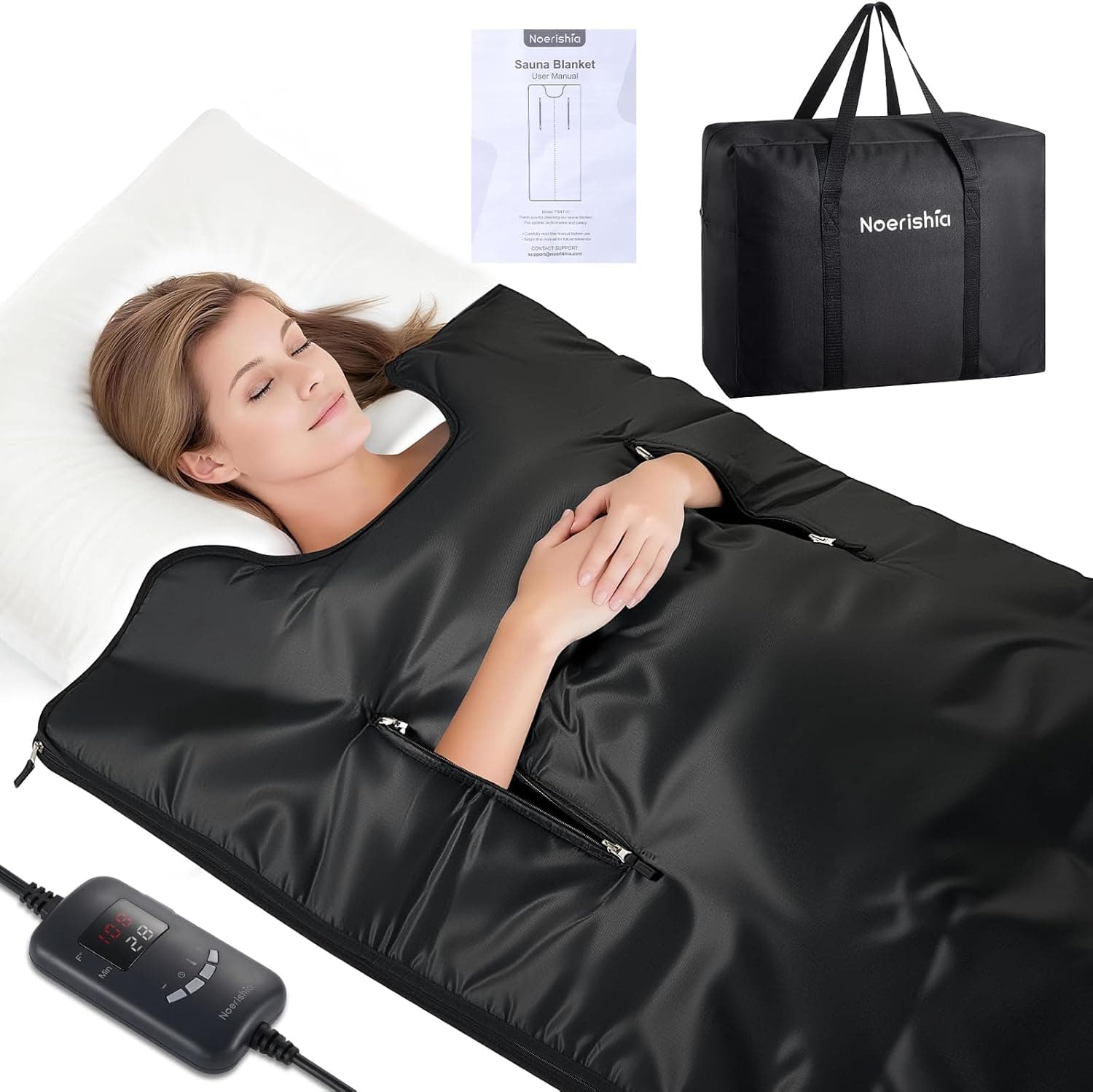
Noerishia Portable Sauna Blanket
Accessible, gentle-temperature-accurate, low-cost option ideal for the cautious starting protocol the evidence supports for fibromyalgia patients. If heat turns out not to be the right modality for you, the budget price makes the trial low-risk. Machine-washable interior supports the frequent use pattern.
Stacking With Other Fibromyalgia Interventions
Heat therapy combines particularly well with graded exercise therapy, which is a cornerstone of fibromyalgia management. Post-exercise sauna blanket sessions can support recovery from the exercise that fibromyalgia patients often find challenging to tolerate. The evidence from Matsumoto specifically used heat plus aquatic exercise, demonstrating the synergy.
CBT for fibromyalgia works on different mechanisms and is a valuable parallel intervention. Sauna session time can be used for relaxation practice, mindfulness, or audiobook listening that supports the cognitive and behavioral work.
Sleep interventions (consistent schedule, cool dark bedroom, evening light reduction) layer cleanly with the sleep benefit of evening sauna use.
Magnesium supplementation, widely used in fibromyalgia for muscle tension and sleep, does not interact negatively with heat therapy and may be particularly well-utilized in conjunction with post-session electrolyte replacement.
What to Track
Weekly: average daily pain on a 0-10 scale, sleep quality on a 0-10 scale, fatigue on a 0-10 scale, and any new or unusual symptoms.
Session-specific: temperature, duration, and subjective response in the 24 hours after.
Longer-term: function measures that matter to you (walking distance, work capacity, social engagement), frequency of flares.
The pattern you are looking for is slow, gradual improvement in pain, sleep, and fatigue over 6 to 12 weeks of consistent practice. Dramatic early changes are unusual; slow and cumulative is the realistic expectation.
When to Stop or Adjust
A consistent post-session flare of pain or fatigue that persists longer than 24 hours is a signal to reduce intensity or frequency. If reducing parameters does not resolve the pattern, heat therapy may not be your right modality.
No improvement after 8 weeks of consistent use is a signal that the intervention is probably not going to produce meaningful benefit for your presentation. It is worth stopping and reinvesting the time in alternatives (different exercise modality, trial of a different medication, CBT initiation, etc.).
New or worsening orthostatic symptoms, new cardiovascular symptoms, or any other unexpected adverse pattern warrants evaluation before continuing.
Realistic Expectations
Best case: 30-50 percent reduction in pain, meaningful improvement in sleep and fatigue, improved function, reduced medication needs. This matches the trial endpoints and is achievable for responders.
Realistic typical case: 15-30 percent reduction in symptom burden, modest improvement in sleep and fatigue, better ability to engage with exercise and social activities. Not transformative but meaningfully better than baseline.
Non-responder case: no measurable improvement, possibly mild worsening of symptoms for the heat-sensitive subset. About 20-30 percent of fibromyalgia patients fall here.
The Bottom Line on Sauna Blankets for Fibromyalgia
The published evidence supports heat therapy as a legitimate adjunctive intervention for fibromyalgia pain, with trial-documented pain reductions on the order of 30 to 40 percent and concurrent improvements in sleep, fatigue, and quality of life. The intervention is most effective when layered on top of standard multimodal care (appropriate medication, graded exercise, CBT, sleep optimization) rather than used as a standalone.
Start conservatively (especially if you have heat sensitivity or autonomic overlap), build slowly, give it 6 to 8 weeks of consistent use before judging, and integrate it with the rest of your fibromyalgia management plan. For responders, a sustainable maintenance protocol of 2 to 4 sessions per week can provide durable symptom benefit. For non-responders, reinvest the time in alternatives that may fit your specific presentation better.
References
- Matsumoto S et al. Thermal therapy combining sauna therapy with underwater exercise in fibromyalgia. Clin Rheumatol. 2011. PubMed 21340676
- Masuda A et al. The effects of repeated thermal therapy for patients with chronic pain. Psychother Psychosom. 2005. PubMed 16155316
- Soejima Y et al. Effects of Waon therapy on chronic fatigue syndrome. Intern Med. 2015. PubMed 25631065
- Macfarlane GJ et al. EULAR revised recommendations for the management of fibromyalgia. Ann Rheum Dis. 2017. PubMed 27377815
Related Reading
- Sauna Blanket for Chronic Fatigue and Long COVID
- Sauna Blanket for Arthritis and Joint Pain
- Sauna Blanket for Autoimmune Conditions
- Sauna Blanket for Sleep Quality
Informational only. Fibromyalgia management requires multimodal specialist-supported care; discuss heat therapy protocols with your physician, especially if you have autonomic dysfunction or significant comorbidities.