Sauna Blanket for Lymphatic Drainage - Does It Actually Work
"Lymphatic drainage" sits in the awkward middle of the wellness marketing space - a real physiological process with real clinical relevance in specific conditions, attached to a set of claims about sauna blankets that often drift well beyond what the evidence supports. I have read through the lymphatic physiology literature and the heat therapy evidence carefully because readers ask about this one often. The honest summary is that sauna blanket use produces measurable increases in lymph flow rate and several downstream effects that are plausibly useful for specific populations, but the marketing framing of "detoxifying the lymphatic system" or "flushing toxins through lymphatic drainage" is a category error about how the lymphatic system actually works.
What the Lymphatic System Actually Does
The lymphatic system is a network of thin-walled vessels and nodes that collects interstitial fluid - the fluid that bathes your cells outside the bloodstream - and returns it to the venous circulation. It filters antigens and pathogens through lymph nodes, supporting immune surveillance. It transports dietary fats absorbed from the gut. It is not, in any meaningful sense, a detoxification system in the way popular language uses that word. Your kidneys and liver are your detoxification organs. Your lymphatic system is a fluid-balance and immune-surveillance system.
This matters because the claims that appear in some sauna blanket marketing - "flushes toxins through lymphatic drainage," "detoxifies through the lymph system," "clears heavy metals through lymphatic activation" - are not consistent with lymphatic physiology. Sweat does mobilize some substances (some heavy metals in very small quantities, some lipophilic compounds), but this happens through the skin and sweat glands, not through lymphatic drainage per se. The concepts are being conflated in a way that obscures rather than clarifies what is actually happening.
That said, there are real and useful effects on lymphatic flow that heat therapy produces, and in specific populations those effects translate into clinical benefit.
What Heat Does to Lymphatic Flow
Lymph flow is driven by three mechanisms: intrinsic rhythmic contractions of the lymphatic vessels (lymphangions), skeletal muscle pump activity, and respiratory pressure changes. Unlike blood, the lymphatic system has no central pump.
Heat exposure increases lymph flow rate through several mechanisms. Vasodilation at the capillary bed increases interstitial fluid production, which increases the lymphatic load and stimulates compensatory flow. Lymphangion contraction rate and amplitude both increase with local temperature elevation. Increased skin blood flow raises the filtration pressure gradient that drives fluid into the interstitium. The net effect is that lymph flow rate increases several-fold during and immediately after heat exposure.
For most healthy people, this increased lymph flow is a neutral or mildly positive physiological event. The lymphatic system is operating under more load but is fully capable of handling it. For people with specific conditions where lymphatic function is already compromised, the increased flow may provide clinical benefit; for a minority, it may not be well-tolerated.
Lymphedema - The Main Clinical Application
Lymphedema is a chronic condition characterized by impaired lymphatic drainage resulting in persistent tissue swelling, most commonly in the arm after breast cancer treatment or in the leg after various surgical or congenital causes. Conventional treatment includes manual lymphatic drainage, compression therapy, exercise, and skin care.
The evidence on heat therapy in lymphedema is mixed and worth understanding carefully. Older literature (primarily from the 1990s and 2000s in Chinese and Eastern European populations) documented reductions in limb volume in secondary lymphedema with regular infrared heat therapy. The mechanism proposed was improved lymphatic flow and reduced tissue inflammation. However, several case reports documented worsening in a subset of patients, particularly those with active inflammation or cellulitis history.
Current Western lymphedema therapy guidelines do not incorporate sauna or heat therapy as standard of care. Most certified lymphedema therapists advise patients to be cautious about heat exposure to affected limbs - the combination of impaired lymphatic function, heat-induced increased interstitial fluid production, and infection risk makes it a mixed-value intervention.
For a patient with lymphedema considering sauna blanket use, the right approach is to discuss it with your lymphedema therapist before starting, and if cleared to try it, to monitor affected-limb circumference carefully before and after sessions and over weeks of use.
Post-Surgical and Post-Injury Swelling
Tissue swelling after surgery or injury has a substantial lymphatic drainage component. Heat therapy may help accelerate resolution of such swelling in some contexts, particularly once the acute inflammatory phase (first 24 to 72 hours) has passed. The evidence here is limited to small case series and extrapolation from manual lymphatic drainage protocols, not from rigorous sauna-specific trials.
For post-cosmetic-surgery swelling or post-injury swelling, the conservative approach is to avoid heat exposure for the first 1 to 2 weeks while acute inflammation resolves, then introduce gentle heat therapy as part of a recovery protocol with clinician guidance. Do not initiate heat therapy over a surgical site without surgeon clearance.
"Detox" Framings That Do Not Match the Evidence
Several common claims about sauna blankets and lymphatic function do not have evidentiary support.
"Flushes toxins through lymphatic drainage." The lymphatic system is not a detoxification system in this sense. Toxin elimination in the physiological sense happens primarily through the kidneys (water-soluble compounds) and liver (lipophilic compounds). Sweat can carry small amounts of some substances, but the quantity relative to renal and hepatic elimination is trivial.
"Activates lymphatic flow for cellulite reduction." There is no published trial evidence supporting sauna blanket use as a cellulite treatment. Cellulite pathophysiology involves subcutaneous tissue architecture and fibrous septae that are not meaningfully modified by heat therapy. Short-term reductions in fluid volume in the area may produce transient cosmetic change that resolves on rehydration.
"Drains lymphatic stagnation." "Lymphatic stagnation" as used in marketing is not a medical diagnosis. Actual impaired lymphatic function (lymphedema, lymphatic filariasis, post-surgical lymphatic injury) is a specific clinical picture treated by specialists.
"Eliminates cellular waste products through lymphatic flow." Cellular waste products are primarily cleared through the circulatory system and processed by the kidneys and liver. The lymphatic contribution is secondary and not materially enhanced by sauna blanket use in any documented way.
What Sauna Blanket Use Actually Does for Fluid and Circulation
The real effects on fluid balance and circulation from regular sauna blanket use include increased peripheral blood flow, improved endothelial function (documented in the Masuda 2005 JACC work), improved microcirculatory flow, transient reductions in tissue edema through vasodilation-mediated fluid redistribution and sweat-mediated fluid loss, and post-session diuresis (some of the redistributed fluid ends up excreted through the kidneys).
Transient reduction in visible puffiness or edema is a real, reproducible effect many users notice. It is not the same as lymphatic drainage and it is not specifically a lymphatic mechanism, but it produces a visible cosmetic effect that some users interpret as "drainage." The mechanism is mostly vasodilation and fluid redistribution rather than lymphatic flow.

Best Whole-Body Coverage for Circulation Benefits
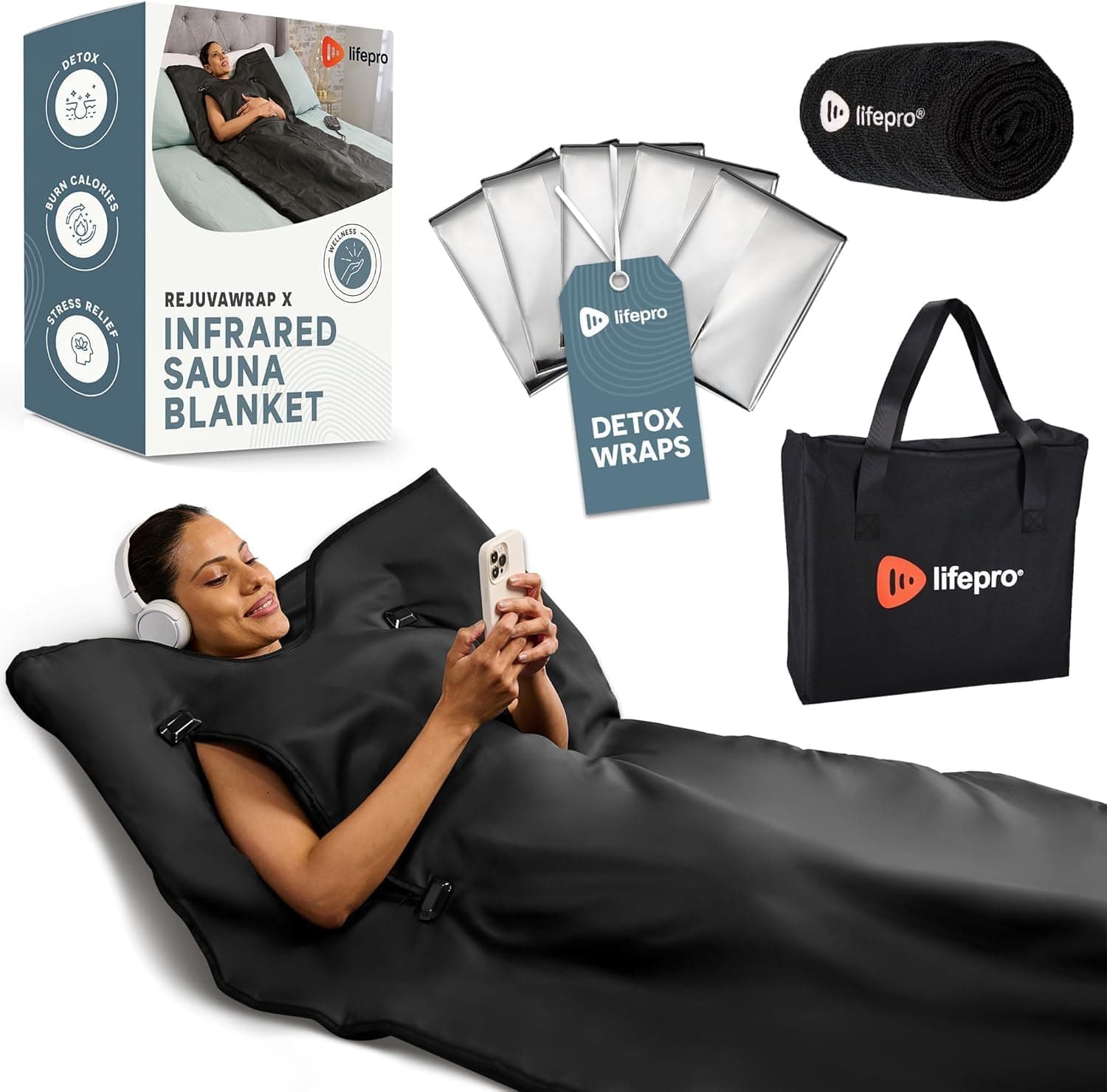
LifePro RejuvaWrap Sauna Blanket
Whole-body coverage, even heat distribution, and the wide temperature range (95-176 F) make this the unit I recommend when the goal is general circulation improvement rather than any specific lymphatic claim. Arm-hole design keeps circulation consistent even during extended sessions.
Combining Sauna Blanket Use With Actual Lymphatic Drainage Techniques
If you are interested in lymphatic drainage for legitimate reasons (post-surgical recovery, mild fluid retention, general wellness practice), the evidence-based techniques are manual lymphatic drainage (MLD) massage and dry brushing. These techniques have been studied independently and are part of standard lymphedema therapy protocols.
Stacking sauna blanket use with MLD or dry brushing is a reasonable practice. Dry brushing before a session may modestly amplify lymphatic flow stimulation. Light manual drainage techniques after a session can be more comfortable because heated tissue is more pliable. Whether this combination produces measurably better outcomes than either alone is not well-studied, but the stacking is physiologically coherent and harmless in most users.
Actual MLD performed by a certified lymphedema therapist is a specific skilled technique and is qualitatively different from the generic marketing claims about "lymphatic drainage" in consumer wellness products.
Who Should Be Careful With Heat Therapy and Lymphatic Function
Several populations warrant specific caution.
Patients with established lymphedema should discuss heat therapy with their lymphedema therapist. Heat exposure can worsen lymphedema in some patients and should be approached cautiously and monitored carefully.
Patients with venous insufficiency or chronic venous disease may find that heat-induced vasodilation worsens venous pooling and leg edema. Compression therapy pre- and post-session may help.
Patients with a history of deep vein thrombosis should discuss heat therapy with their physician. Acute DVT is a clear contraindication. Remote history without active disease is typically permissive, but clinician input is prudent.
Patients on long-term anticoagulation should be aware that heat-induced lightheadedness or fainting carries amplified injury risk.
Patients with active inflammation or infection in a limb should not use heat therapy over the affected area.
The Bottom Line on Sauna Blankets and Lymphatic Drainage
Sauna blankets produce real increases in lymph flow rate during and after sessions, mediated by vasodilation, increased interstitial fluid production, and increased lymphangion contraction. For most healthy users this is a physiologically benign or mildly positive effect. For patients with established lymphedema or specific post-surgical presentations, the clinical balance is mixed and requires clinician guidance.
The marketing framing of sauna blankets as "lymphatic drainage" or "detoxification" interventions significantly overstates what the physiology actually supports. Regular sauna blanket use produces well-documented cardiovascular, autonomic, and stress-reduction benefits; lymphatic-specific benefits are a small and over-marketed subset of the real effects.
If lymphatic function is a legitimate concern for you (lymphedema, post-surgical lymphatic injury), work with a certified lymphedema therapist and make decisions about heat therapy in that context. If general circulation and fluid balance are the goal, sauna blanket use is a reasonable adjunct whose effects are real but whose lymphatic framing has been oversold.
References
- Masuda A et al. Repeated thermal therapy improves impaired vascular endothelial function. J Am Coll Cardiol. 2005. PubMed 16098438
- International Lymphoedema Framework. Best Practice for the Management of Lymphoedema. lympho.org
- Lymphatic Education and Research Network (LERN). lymphaticnetwork.org
Related Reading
- Sauna Blanket Detox - What the Science Says
- Sauna Blanket Skin Benefits
- Sauna Blanket and Blood Pressure
Informational only. Lymphedema and related conditions require specialist care; do not substitute heat therapy for evidence-based lymphatic therapy.