Sauna Blanket for Athletic Recovery - HRV, DOMS, and Endurance Adaptation
Recovery is the rate-limiting factor for most serious trainers, and the question of whether a sauna blanket accelerates recovery shows up in my inbox constantly. The evidence on heat therapy in athletic contexts is strong enough in some domains (heat acclimation for endurance performance) and suggestive enough in others (DOMS, HRV, sleep-mediated recovery) that I have integrated sauna blanket use into my own training routine for the past three years. This article walks through the objectively measured recovery variables - DOMS, heart rate variability, sleep, plasma volume, inflammatory markers - and tells you honestly which ones respond and by how much.
Delayed Onset Muscle Soreness - What the Data Shows
Post-exercise heat therapy for DOMS has been studied in several small trials with mixed but generally positive results. Petrofsky et al. (2013) examined moist heat applied immediately after eccentric exercise and documented reduced DOMS scores at 24 and 48 hours compared to control. Park and colleagues (2017) extended this to whole-body heat exposure post-training and found similar directional benefits.
The mechanism is probably multi-factorial: improved blood flow to damaged muscle tissue supports clearance of inflammatory mediators, heat shock protein induction provides some cellular protection against ongoing damage, the parasympathetic rebound supports recovery physiology, and the subjective analgesic effect of warmth reduces the perception of pain.
Importantly, this is different from cold immersion for DOMS, which also reduces soreness but may partially blunt some adaptations to training. The tradeoff profile of heat versus cold for recovery is a real discussion and the choice depends on what you are optimizing for.
For DOMS-focused use of a sauna blanket, the protocol that appears to work best is a 30 to 45 minute session starting 1 to 2 hours post-training. Running the session immediately post-training can actually amplify inflammation in the short term; a brief delay lets the initial post-exercise response resolve before adding the heat stressor. By 24 to 48 hours post-training, subjective soreness is typically noticeably reduced compared to no-intervention baseline.
Heart Rate Variability Recovery
HRV is probably the most objective single marker of recovery status available to athletes without a lab. Low HRV indicates sympathetic dominance and incomplete recovery; rising HRV toward personal baseline indicates parasympathetic rebound and readiness to train hard again.
Heat therapy appears to support HRV recovery in several study contexts. Kakamu et al. (2022) documented improved next-morning HRV in amateur athletes using post-exercise sauna compared to exercise-only controls. Mourot et al. (2010) found HRV improvements with sauna included in a training program for cardiac patients.
In my own HRV tracking over three years, sauna session days consistently correlate with higher next-morning HRV scores than non-sauna days with similar training loads. This is not rigorous evidence but it is consistent with the trial literature.
The practical application: if you track HRV and see a pattern where certain training sessions produce long drops in HRV that take multiple days to recover, adding a sauna blanket session on the same day as those sessions may accelerate return to baseline.
Sleep-Mediated Recovery
Much of athletic recovery happens during sleep, and sauna blanket use improves sleep quality in most users (see the dedicated sleep article). The sleep mechanism is mediated by core temperature manipulation and parasympathetic shift; the recovery benefit flows from better sleep on heavy training days.
For athletes, this is often the most practically important benefit. A night of 30 minutes more deep sleep after a hard training day translates to meaningful next-day readiness improvement. The evening sauna session timed 90 to 120 minutes before bed, discussed in the sleep article, is the timing that maximizes this effect.
Plasma Volume Expansion and Endurance Performance
Repeated heat exposure over 7 to 14 days produces plasma volume expansion on the order of 5 to 10 percent. Plasma volume is a primary determinant of stroke volume, maximal cardiac output, and thermoregulatory capacity - making it one of the most valuable adaptations in endurance athletics.
Lorenzo et al. (2010, J Appl Physiol; PubMed 20724557) demonstrated that 10 days of heat acclimation produced measurable endurance performance improvements in trained cyclists even when tested in cool conditions, with the plasma volume expansion as the proposed mechanism. Subsequent work (Scoon 2007, Racinais 2015) has replicated and extended these findings.
The protocol for plasma volume expansion is 60 to 90 minutes of heat exposure daily for 10 to 14 days, producing core temperature elevation to approximately 38.5 to 39 degrees Celsius. This protocol can be run pre-event for a target competition, or as a periodic block twice a year to maintain the adaptation baseline.
Inflammatory Marker Response
Regular heat therapy reduces baseline inflammation markers across multiple study contexts. Reductions in IL-6, CRP, and TNF-alpha have been documented with sustained regular sauna use. For athletes, lower baseline inflammation may translate to improved recovery capacity and reduced injury risk, although direct evidence on injury rates is limited.
Post-workout sauna may amplify this anti-inflammatory effect. The Gayda 2012 trial, while not focused on inflammatory markers specifically, documented superior recovery markers with post-exercise sauna compared to either modality alone. For athletes with high training loads and elevated baseline inflammation, this effect may be particularly valuable.
Heat Shock Protein Response and Training Adaptation
Heat shock proteins (especially HSP70 and HSP90) are induced by heat exposure and have documented roles in muscle repair, protein folding, and cellular stress tolerance. Repeated heat exposure over weeks upregulates baseline HSP expression, plausibly supporting training adaptation and recovery.
Stacey et al. (2018) documented amplified HSP70 expression in post-resistance-training muscle biopsy samples when heat exposure was added after the session. Whether this translates into measurably better strength or hypertrophy outcomes over weeks is still under investigation.

Best for Athletic Recovery Integration
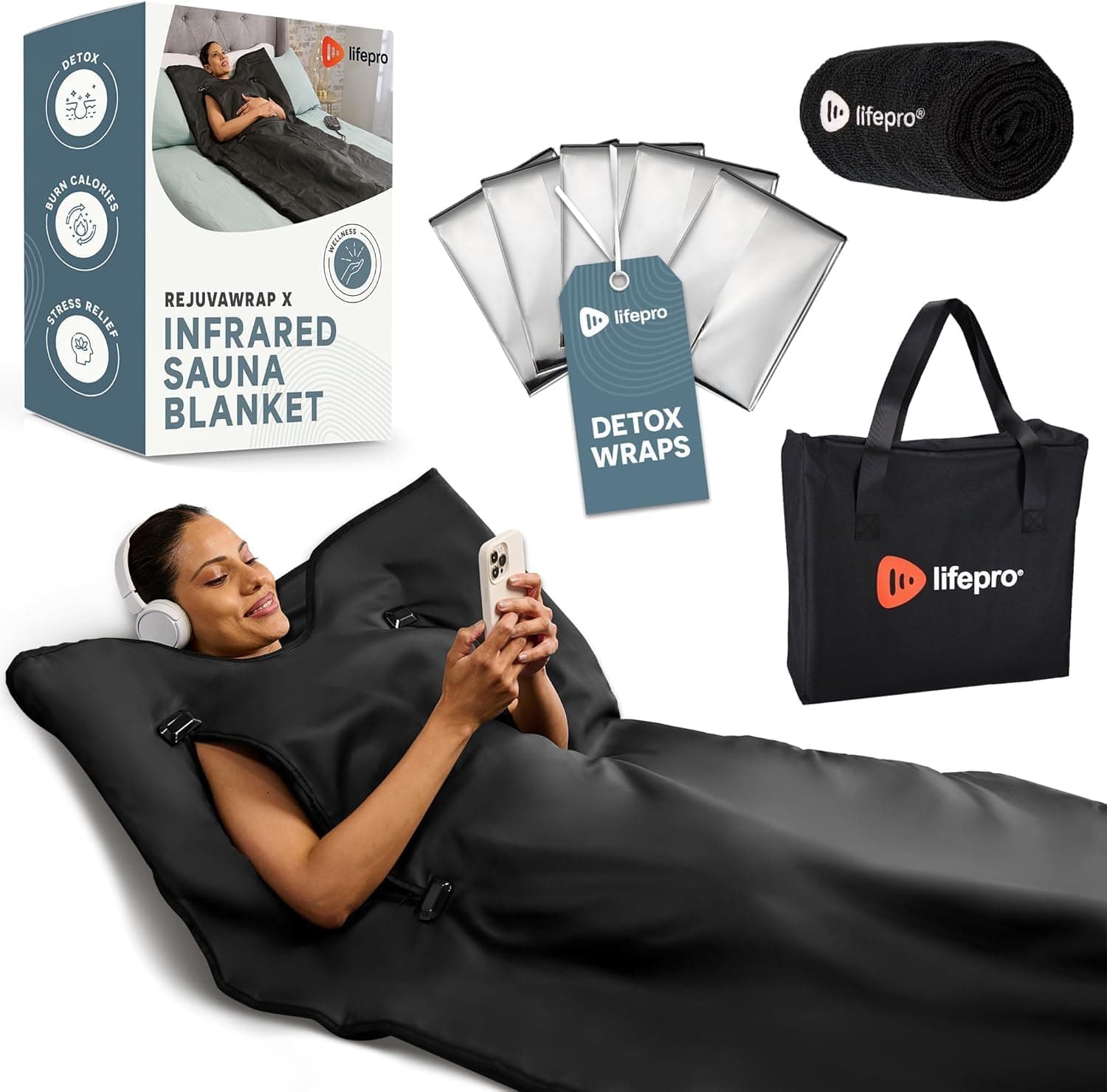
LifePro RejuvaWrap Sauna Blanket
The temperature range (up to 176 F), arm-hole design for during-session hydration, and consistent session-to-session performance make this the unit I use myself for recovery-focused protocols. Durable enough for 5+ sessions per week without degradation.
The Integrated Recovery Protocol
For a training program incorporating sauna blanket use for recovery, the protocol I have found works well and is consistent with the evidence base is:
Hard training days: 30 to 45 minute sauna session 1 to 2 hours post-workout. Aggressive rehydration. Evening session timing is also good if schedule permits. Total session temperature around 60 to 65 degrees Celsius.
Moderate training days: 20 to 30 minute session post-workout or in the evening. Lower priority than on hard days.
Recovery days: 30 to 45 minute stand-alone session. This is often where the clearest subjective recovery benefit is felt.
Peak week / competition week: reduce volume to 2 sessions for the week, both at lower intensity. The sauna is an additional stressor and should be managed accordingly during peak windows.
Heat acclimation block (pre-event or seasonally): daily sessions for 10 to 14 days, progressing from 30 to 60 minutes, at 60 to 65 degrees Celsius. Time post-workout when possible.
Contrast Therapy - Heat and Cold Together
Some athletes combine heat and cold therapy in the same recovery session (contrast therapy). The evidence on contrast is mixed - some trials show recovery benefit, others show no added benefit compared to single-modality, and the signaling effects of heat and cold may partially cancel.
A reasonable contrast protocol if you have access to cold water or an ice bath: 10 to 15 minute sauna session, 2 to 3 minute cold plunge, repeat 2 to 3 times. End on cold. This contrasts the parasympathetic heat response with the sympathetic cold response and may provide modest recovery benefit, though the evidence is not definitive.
For athletes optimizing purely for recovery and sleep, heat alone (sauna blanket only, no cold) produces the cleanest parasympathetic signal and may support next-day readiness better than contrast. For athletes optimizing for subjective recovery and mood, contrast can feel better and produce a bigger acute mood lift. Goal-dependent.
Common Mistakes Athletes Make
Inadequate hydration is the most common mistake. Stacking 1 to 2 liters of sweat loss from training on top of 500 to 1200 milliliters from a sauna session without aggressive fluid and electrolyte replacement produces cumulative deficit that compromises the recovery it was meant to support.
Sauna-ing too hard during peak competition weeks. The sauna is a stressor; during windows where you are trying to minimize total stress, reduce sauna volume.
Pre-workout sauna before high-intensity sessions. Compromises performance without clear benefit.
Ignoring HRV and subjective recovery data in favor of protocol rigidity. The evidence-based protocol is a starting point; your individual response data is the more important input over time.
Treating sauna as a replacement for sleep. Heat therapy improves sleep quality but does not substitute for adequate sleep duration. Sleep debt is not repayable through heat therapy alone.
When Athletes Should Not Use Sauna Blankets
During acute illness, particularly with fever. Compounding thermal load on an already elevated core temperature is a poor idea.
When significantly dehydrated (weight more than 2 percent below morning baseline). Rehydrate first, sauna later.
Within 12 to 24 hours of a very hard workout that produced exceptional cardiovascular strain. The cardiovascular demand of a session on top of a maximally stressed cardiovascular system is not helpful.
During a taper window for a peak event (last 3 to 7 days). Maintenance-only or skip.
If HRV has been suppressed for multiple days suggesting overreaching or sub-clinical illness. Recover the HRV first with lighter training and no additional stressors.
The Bottom Line on Sauna Blankets for Athletic Recovery
Sauna blanket use is a legitimately useful recovery modality for serious trainers, with the strongest evidence in endurance performance adaptation (via heat acclimation and plasma volume expansion), post-workout cardiovascular and HRV recovery, and sleep-mediated overall recovery. DOMS reduction is real but modest. Hypertrophy effects are unclear.
Integrated thoughtfully into a training program with post-workout or evening timing, aggressive hydration management, and reduced volume during peak weeks, it can produce measurable improvements in training capacity and subjective well-being over months of consistent use. Used carelessly - pre-workout before hard sessions, under-hydrated, at high volume during peak weeks - it can harm recovery rather than help.
References
- Lorenzo S et al. Heat acclimation improves exercise performance. J Appl Physiol. 2010. PubMed 20724557
- Scoon GS et al. Post-exercise sauna bathing and endurance performance. J Sci Med Sport. 2007. PubMed 16877041
- Racinais S et al. Consensus recommendations on training and competing in the heat. Scand J Med Sci Sports. 2015. PubMed 25943654
- Gayda M et al. Sauna alone and postexercise sauna for blood pressure. J Clin Hypertens. 2012. PMC8108777