Sauna Blanket and Menopause - Hot Flashes, Hormones, and What Actually Works
The question of whether a sauna blanket can help with menopausal symptoms is one of those areas where the intuitive answer ("more heat will make hot flashes worse") and the actual evidence ("regular controlled heat exposure may reduce hot flash frequency") sit in tension. I have walked through the literature carefully because I receive this question often, and the picture that emerges is more interesting and more nuanced than either the marketing copy or the dismissive skepticism would suggest. There is real clinical evidence for symptom relief in vasomotor, musculoskeletal, urologic, and psychological symptom domains. There is no evidence for hormonal modification. And there are specific safety considerations that matter more in the perimenopausal and postmenopausal years than they did before.
This article walks through what the research shows, what to expect realistically, the protocol that reflects the strongest study designs, and where the safety profile changes for women in this life stage.
The Most Relevant Study - Yang et al. on FIR Therapy in Postmenopausal Women
The single most useful study for our purposes is Yang and colleagues, published in 2012 in Maturitas (PubMed 22104026). The intervention was local far-infrared thermal therapy applied to the abdomen for 40 minutes per session, twice weekly, for 10 weeks. The endpoints were the Menopause Rating Scale (MRS) domains and serum hormone and bone markers.
The MRS results were notable. Significant reductions in the vasomotor domain (covering hot flashes, sweating, and night sweats), the musculoskeletal domain (joint and muscle complaints), the urogenital domain (bladder problems, vaginal dryness), and the psychological domain (anxiety, irritability, depression, fatigue) were all documented at the p less than 0.05 threshold. The hormonal endpoints were equally important but for the opposite reason: serum estradiol, osteocalcin, and bone mineral density showed no measurable change. This is the clean evidence pattern that supports the framing throughout this article: heat therapy in menopause appears to provide genuine symptomatic benefit through thermoregulatory and circulatory mechanisms, not through hormonal modification.
The Yang study is the most rigorous human trial on heat therapy in menopause that we have, and its results have not been contradicted by subsequent work. It is also small, single-arm in some respects, and used FIR locally rather than the whole-body envelopment of a sauna blanket - so the extrapolation is not perfect. But the mechanism is the same and the clinical signal is consistent with everything else in the literature.
The Hot Flash Mechanism - Why Heat Therapy Helps Rather Than Hurts
The biology behind this counterintuitive finding is worth understanding. A hot flash is fundamentally a thermoregulatory failure. The hypothalamic temperature set point becomes narrowed and unstable in the menopausal transition, and small fluctuations in core temperature that would not have triggered a thermoregulatory response premenopause now drive sudden vasodilation, sweating, and the felt experience of a hot flash. Estrogen withdrawal is the proximate cause; the downstream effect is a hypothalamus that has lost some of its tolerance band.
Heat shock proteins - particularly HSP70 - play a central role in cellular thermal tolerance. Estrogen normally upregulates HSP70 expression. When estrogen declines, HSP70 expression declines, and thermoregulatory tolerance narrows. Repeated mild hyperthermia from heat therapy is one of the few interventions known to upregulate HSP70 expression independently of estrogen status. The hypothesis that drives the clinical finding is that heat therapy substitutes a non-hormonal mechanism for what estrogen used to do, restoring some of the thermoregulatory bandwidth and reducing hot flash frequency and severity over weeks of regular exposure.
An animal study often cited in this space examined aged ovariectomized female mice (a model for postmenopausal physiology) exposed to repeated heat therapy. The treated mice showed augmented HSP70 response and significantly fewer hot flash-equivalent episodes compared to controls. This is mechanism-level evidence consistent with what the human Yang trial showed at the symptom level.
The practical implication: the first one or two sauna blanket sessions might transiently provoke a hot flash. Over weeks of consistent use, the trajectory should reverse and hot flash frequency and intensity should decline. If you give it three or four weeks of twice-weekly sessions and the pattern is not yet emerging, it may not be your responder profile, and that is worth knowing.
What Sauna Blankets Do Not Do for Menopause
The hormonal endpoints in the Yang study are as informative as the symptomatic ones. Serum estradiol did not change. Bone density did not change. Osteocalcin (a marker of bone turnover) did not change. The cortisol and other endocrine effects sometimes claimed in marketing copy are at best unverified at the clinically meaningful level for this population.
This means several things in practical terms. A sauna blanket is not a replacement for hormone replacement therapy if your physician has indicated HRT for your specific picture. It is not a bone health intervention - the established interventions (resistance exercise, adequate calcium and vitamin D, pharmacotherapy when indicated) are not replaced by heat therapy. It is not going to alter your cardiovascular risk profile in the substantial way that HRT can in appropriate candidates. The role of heat therapy in menopause is symptom management and quality of life, not endocrine or skeletal disease modification.
The Sleep, Mood, and Energy Improvements
One of the more consistent findings across the heat therapy literature in menopausal women is improvement in sleep quality. Several mechanisms likely contribute: the post-session decrease in core temperature in the 90 minutes following a session aligns with the temperature drop that promotes sleep onset, the parasympathetic shift over weeks of regular use supports sleep architecture, and the reduction in night sweat and hot flash frequency removes one of the most common sleep-disrupting symptoms of menopause.
Mood and energy improvements are more anecdotally reported and harder to disentangle from sleep effects, but the Yang MRS data showed clean improvements in the psychological domain. For women whose menopausal symptom burden includes mood disturbance, the pathway from "better sleep" to "better mood" is a well-established one and probably accounts for a substantial share of the observed psychological benefit.

Best for the 10-Week Menopause Symptom Protocol
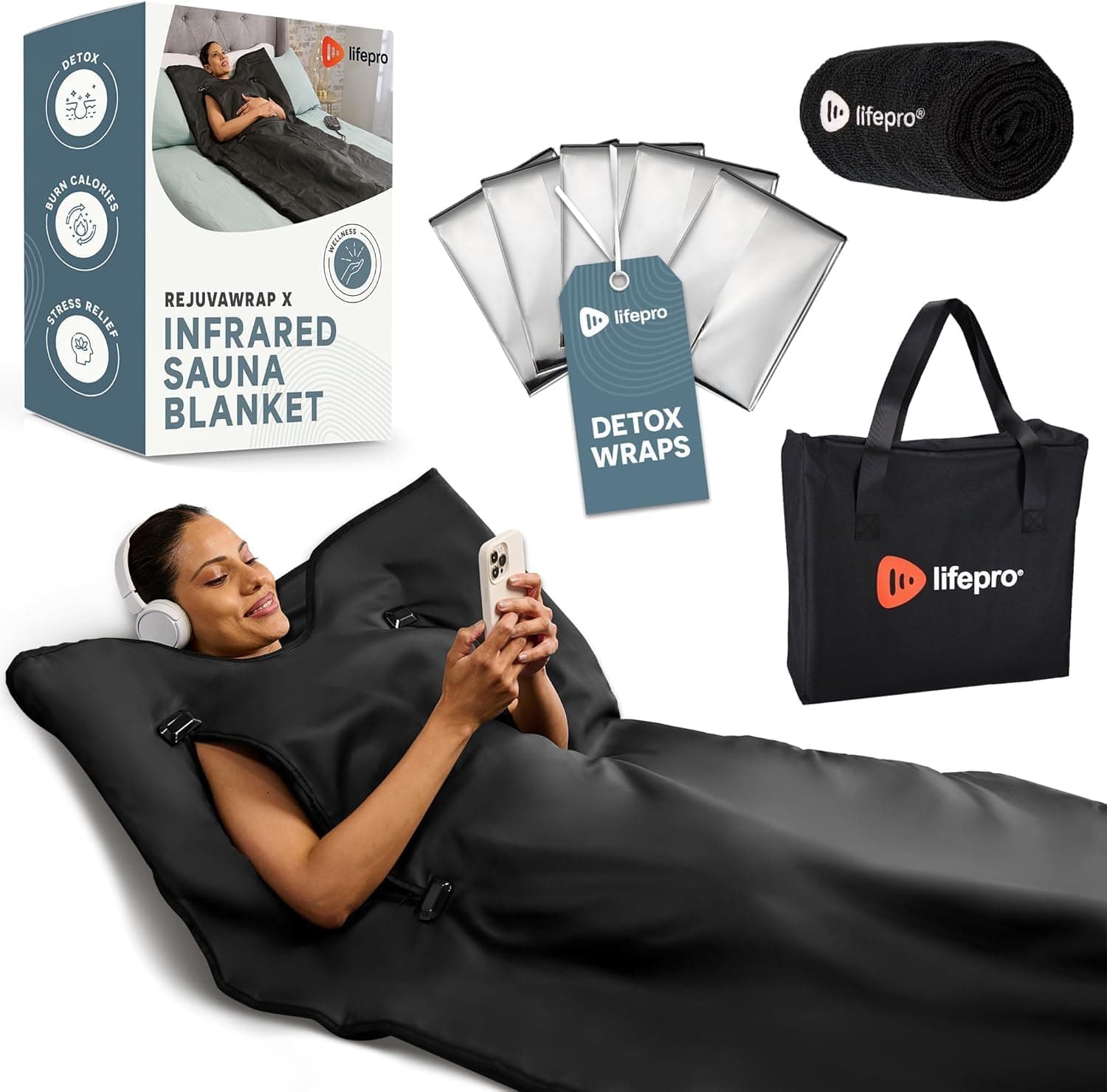
LifePro RejuvaWrap Sauna Blanket
The wide temperature range (95-176 F) and arm-hole design are well suited to the conservative starting protocol that the menopause evidence supports - lower temperatures, longer sessions, twice weekly. The arm holes let you keep water close at hand, which matters more during perimenopause when hydration baseline can shift.
Safety Considerations Specific to This Life Stage
Several physiological changes that accompany the menopausal transition modify the safety calculus for heat therapy in ways worth knowing.
Cardiovascular risk shifts. Estrogen withdrawal is associated with an increase in cardiovascular event risk, and many women receive new diagnoses of hypertension, dyslipidemia, or insulin resistance in the perimenopausal and early postmenopausal years. If you have received a recent cardiovascular diagnosis or started new cardiovascular medications, the conversation about heat therapy belongs with your physician before you start.
Bone density considerations. While sauna blanket use does not appear to harm bone density, women with osteoporosis or osteopenia who experience heat-induced dizziness and fall on a hard floor face fracture risk that someone with normal bone density does not. The exit protocol matters more in this population.
Hot flash interaction. As noted above, the first few sessions can transiently worsen vasomotor symptoms before the adaptation kicks in. Plan accordingly - do not run your first session right before an important meeting or social event.
Vaginal dryness and skin sensitivity. Skin and mucous membrane changes can make some women more susceptible to heat-related discomfort. Pay attention to skin signals during the early sessions; if any patch of skin is reading abnormally hot or red, end the session and check the heating element distribution.
Hydration baseline. The fluid balance physiology of menopause can shift in subtle ways, and the dehydration risk of heat therapy needs to be respected accordingly. Drink ahead of sessions and replenish electrolytes as well as water afterward.
The Evidence-Based Protocol
Reflecting the Yang study and the broader heat therapy literature, the protocol with the cleanest evidence base for menopausal symptom management is approximately as follows: 30 to 45 minute sessions at 50 to 60 degrees Celsius, twice weekly, sustained for 8 to 12 weeks before judging effectiveness. Morning or early evening sessions tend to work better for most women than late evening sessions, although for women whose primary symptom burden is night sweats, an evening session two to three hours before bed may be the right timing. Hydrate with water and an electrolyte source before and after each session.
Track which symptoms you are targeting and rate them weekly on a simple 1-to-10 scale. Hot flash frequency over a representative 24-hour period, sleep quality, and overall mood are the three I find most useful to track. The pattern you are looking for is gradual improvement starting around week 3-4 with maximal effect around week 8-10. If no signal has emerged by week 6, the intervention is probably not going to move your particular symptom profile in a meaningful way.
What Heat Therapy Pairs Well With
Sauna blanket use stacks well with the established lifestyle interventions for menopausal symptom management. Regular resistance exercise (independently the strongest non-pharmacologic intervention for menopausal bone health and metabolic risk) does not interact negatively with heat therapy and may amplify it. Adequate sleep hygiene, including a cool bedroom and consistent sleep schedule, complements the post-session temperature drop. Hot flash trigger management - reducing alcohol, caffeine, and identifiable food triggers - works alongside the heat therapy adaptation rather than against it.
If you are on an SSRI or SNRI for vasomotor symptoms, there is no specific interaction with heat therapy, although the autonomic effects of those medications can occasionally produce more pronounced post-session sweating in some patients. If you are on hormone therapy (oral or transdermal estrogen with or without progesterone), there is no contraindication to combined use, and the interventions appear to have additive symptomatic effects in clinical reports.
The Perimenopausal Picture
Most of the published research is in postmenopausal women, where hormonal status is relatively stable. The perimenopausal years are characterized by larger and more unpredictable fluctuations, and the symptom picture can be more variable session-to-session. The same protocol applies, but expectations about week-to-week response should be calibrated downward - the noise in your underlying physiology is larger and the signal of intervention effect is correspondingly harder to detect quickly. Give it the full 8 to 12 weeks before judging.
Where the Marketing Goes Wrong
Some sauna blanket marketing in this space makes claims that the evidence does not support. "Hormone balancing" as applied to sauna blanket use does not have a clean evidence base; serum hormone levels do not appear to change in human studies. "Detoxifying estrogen metabolites" is not a meaningful framing of what sweating does. "Replacing HRT" is an unsupported and clinically inappropriate claim. "Reversing menopause" is not a thing.
The honest framing is that heat therapy may help with hot flashes, sleep, mood, and joint stiffness through documented thermoregulatory and circulatory mechanisms. Anything more ambitious requires evidence that does not yet exist.
The Bottom Line on Sauna Blankets and Menopause
The evidence supports sauna blanket use as a symptom management adjunct in the menopausal transition - meaningful potential reductions in hot flash frequency and intensity, improvements in sleep quality, reduction in joint and musculoskeletal complaints, and improvement in mood and energy, all on a 6 to 12 week timeline of consistent twice-weekly use. The evidence does not support hormonal modification, bone preservation, or replacement of established therapies for menopausal management.
For a healthy woman in perimenopause or postmenopause without a cardiovascular contraindication, who has cleared the conversation with her physician, a sauna blanket protocol is a reasonable, low-risk addition to a symptom management plan. The risk profile is well within tolerance for most women in this group, the time commitment is modest, and the symptomatic upside is genuine even if it is not transformative.
References
- Yang TH et al. The therapeutic effects of FIR thermal therapy on postmenopausal women. Maturitas. 2012. PubMed 22104026
- Hussain J, Cohen M. Clinical Effects of Regular Dry Sauna Bathing - A Systematic Review. Evid Based Complement Alternat Med. 2018. PMC5941775
- Laukkanen JA et al. Sauna bathing and cardiovascular outcomes in mixed-sex populations. Mayo Clin Proc. Series of papers, Finland. PubMed 25705824
- North American Menopause Society Position Statement on Hormone Therapy. menopause.org
Related Reading
- Sauna Blanket Side Effects - Complete Risk Analysis
- Sauna Blanket for Sleep Quality
- Sauna Blanket for Anxiety and Stress Reduction
- Sauna Blanket and Blood Pressure
Informational only. Menopause management is individualized and decisions about hormone therapy and other interventions belong with your treating physician.